Do People Buy Instagram Followers? 2 Studies, No Headcount
Quick answer
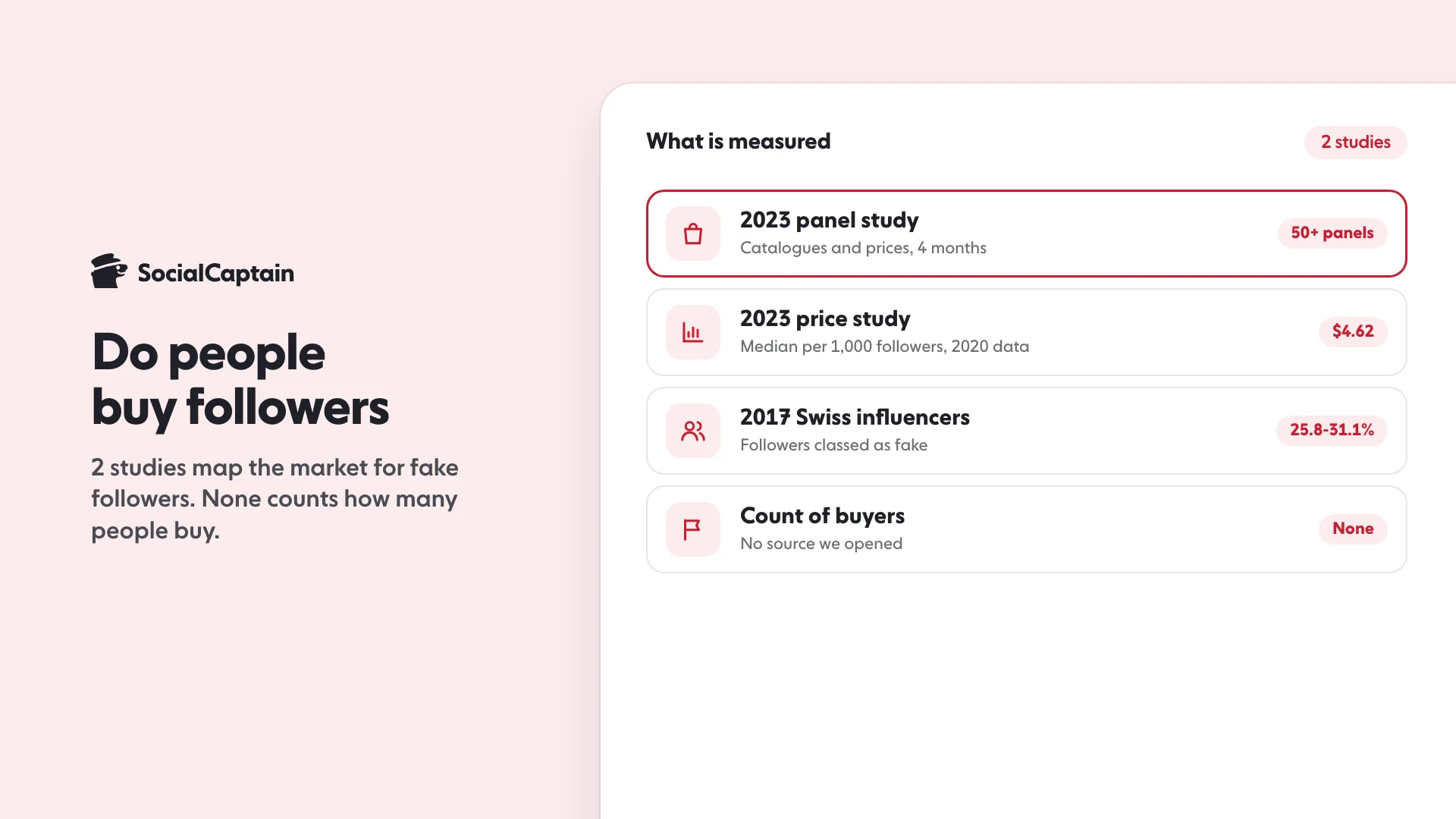
Yes, people buy Instagram followers: a 2023 study found more than fifty resale panels and 4,057 follower listings at a median $4.62 per 1,000 (2020 data). No source we opened counts the buyers or gives a share of accounts that bought.
- A 2023 study found 50+ resale panels; Instagram followers median $4.62 per 1,000.
- SRF Data (2017) classed 25.8% to 31.1% of 115 Swiss influencers' followers as fake.
- No source we opened counts how many people buy followers; we give no share.
On this page10 sections
Yes, people buy Instagram followers, and the market is large enough to measure: a 2023 study found more than fifty resale panels, with 4,057 Instagram follower listings at a median $4.62 per 1,000 (2020 data). What no source we opened gives is a count of the people who buy, or a share of Instagram accounts that bought followers. This page goes through 2 studies, 2 official statements and what each one does and does not show. Where there is no number, it says so and leaves the gap empty.
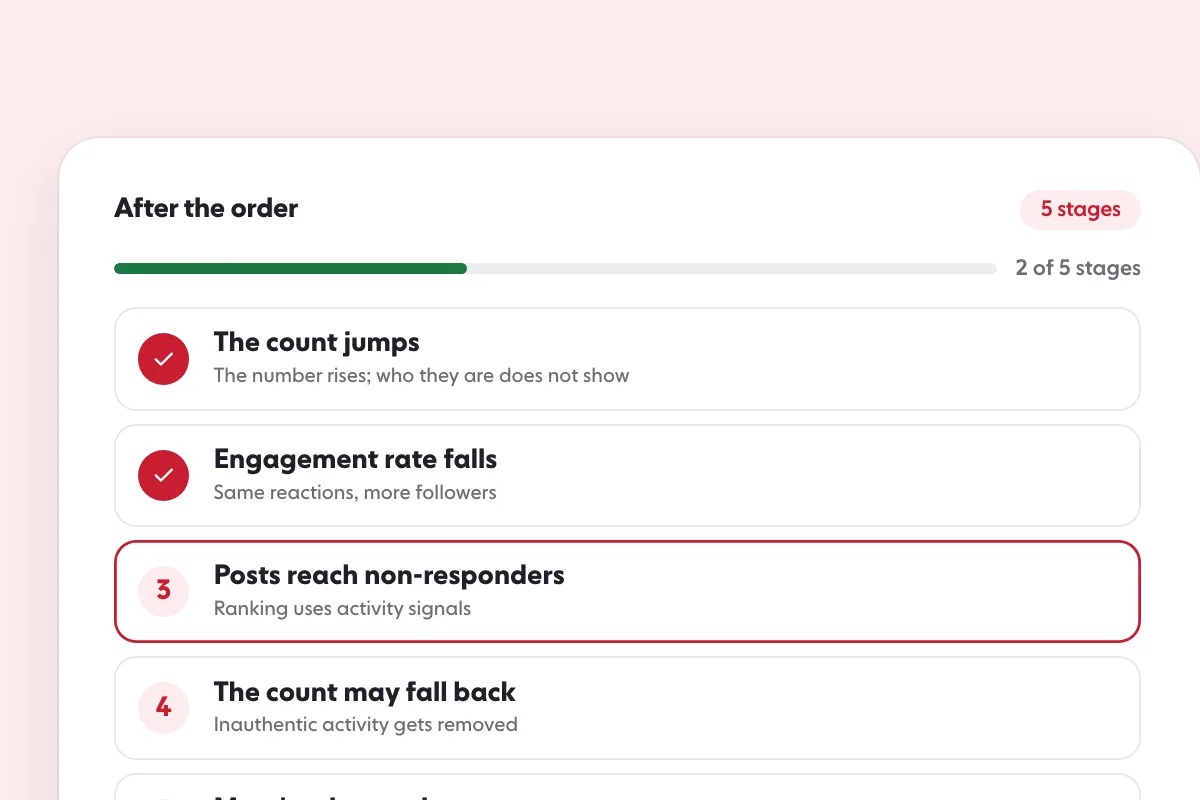
If you want to know what happens to an account after a purchase, read What Happens When You Buy Instagram Followers: 5 Stages. If you want to check a profile for signs of bought followers, read How to Check If Someone Bought Instagram Followers: 7 Signs. This page answers a different question: how common buying is, and what the evidence says about why.
Do people buy Instagram followers?
Yes. The evidence is on the supply side: researchers and trackers can see what is for sale, so that is what they count. The tables list every source we used, the two studies first and the two official statements second, with who produced it, when, how big the sample was and what it shows.
| Source | Who, when, how big | What it shows | What it does not show |
|---|---|---|---|
| IMDEA Networks and Universidad Carlos III de Madrid, published in Computers & Security (2023) | More than fifty resale panels, catalogue and prices collected every day for 4 months | A large catalogue of fake interaction services, choice of country and gender, wide price gaps; in the paper’s price table, a median of $4.62 per 1,000 Instagram followers (4,057 listings, middle half $2.20 to $8.50), 2020 data | How many people buy, or what was delivered |
| SRF Data investigation (Swiss public broadcaster’s data team), October 2017 | About 7 million followers of 115 Swiss Instagram influencers | 25.8% to 31.1% of those followers classified as fake | Whether any follower was bought, or any figure outside that group |
The two official statements:
| Source | Who, when, how big | What it shows | What it does not show |
|---|---|---|---|
| Instagram’s post of 19 November 2018 | A platform statement | Accounts were using third-party apps to grow artificially, and Instagram began removing the activity | A number of accounts |
| New York Attorney General release, 30 January 2019 | One settlement announcement | A seller’s customers included people who knew the activity was fake | Anything specific to Instagram |
Read across the rows, the pattern is the same. There are many sellers, the prices are low, and the studies that measure the market measure it from the seller’s side.
How many people buy Instagram followers?
No source we opened gives a number, and the people who study the market say why. The IMDEA Networks news item about the 2023 study notes that some platforms report on what they call “inorganic behaviour”, especially the volume of deactivated accounts and what the accounts were used for, and then adds: “the total volume of fake interactions on current platforms is unknown”. The same item says the researchers’ aim was to quantify the global market price of services that resell artificial interactions, something that “has rarely been studied in academic literature”.
Listing counts are not buyer counts. The 2023 paper counted 4,057 Instagram follower listings on more than fifty panels, read every day for about 4 months in 2020, and found a median of $4.62 per 1,000 followers. Those figures tell you the supply is large and cheap. A shop can list a thousand products and sell ten. The paper measures listed prices, not what was delivered, how long followers stayed, or whether the accounts were real. We found no newer primary study of pack prices, so $4.62 is the latest measured market, not today’s quote.
So any page that gives “X% of people buy followers” for Instagram as a whole is stating something we could not find a primary source for. We do not give one. A figure from a vendor survey or a marketing blog is a claim until its method is public, and we used none.
What share of Instagram followers are fake?
The closest evidence is the SRF Data investigation, and it is narrow. SRF is the Swiss public broadcaster, and its data team published the work in October 2017 with its code and method. It looked at the followers of 115 Swiss Instagram influencers: about 7 million unique accounts, gathered in the second half of August. The team labelled a sample by hand, trained a statistical model on it and applied the model to all followers. Its published accuracy on a held-out test set was about 94.4%.
The results, in the authors’ words and numbers:
- All followers together: the model classified 25.8% to 31.1% of the roughly 7 million followers as fake.
- Influencer by influencer: the unweighted mean was 26.4% to 31.5% fake followers, and the median was 14.3% to 19.6%. The mean sitting above the median suggests that a minority had very high shares.
- The high end: about 30 of the 115 influencers appeared to have more than 50% fake followers.
- Two groups: the authors saw one cluster of influencers with under 25% fake followers and one with between 25% and 75%. They suspect, and say they cannot prove, that the second group’s followers were “actively procured” by the influencer or by a third party.
Four limits are in the authors’ own text, and they matter more than the headline.
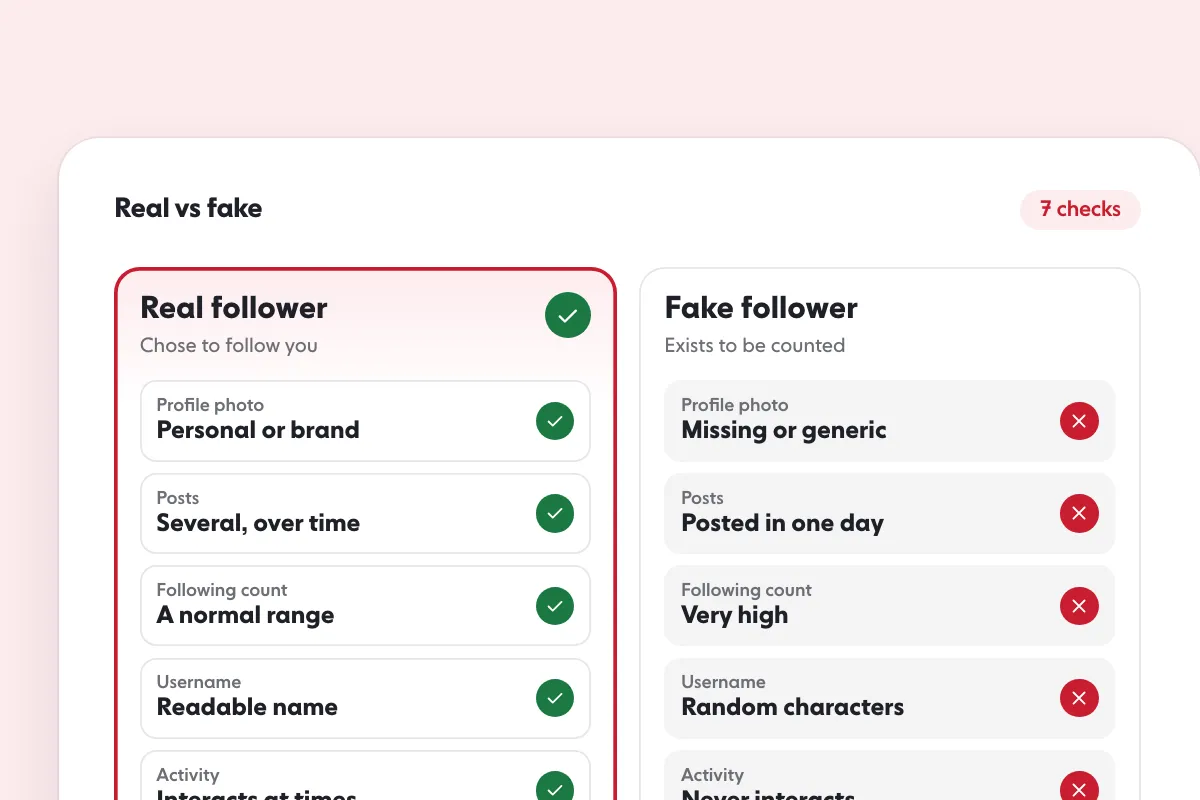
- The definition is theirs. They call a follower fake if, for example, it follows an exorbitant number of accounts, has almost no posts, no profile picture, a private account and a username with many numbers. They say the definition “depends mainly on human intuition” and that no generally accepted one exists.
- The group is not all of Instagram. It is 115 influencers chosen by the team, in one country, in 2017. The authors warn that their list may miss key players.
- Fake is not the same as bought. They write that they “don’t know and cannot confirm whether these fake followers were effectively purchased by these influencers themselves”.
- It is old. The follower lists date from August 2017, and we did not find a newer study of this kind that we could open.
So the number answers “how many followers of these influencers looked fake in 2017”, and not “how many people buy followers”.
Who buys Instagram followers?
The sources we opened give a short list, and none of it is a headcount.
The IMDEA authors say potential consumers “can be anyone depending on the type of review: from influencers who want to promote their channels on social media to brands trying to promote the visibility of their products”. That quote is from one of the study’s authors, in the news item, and it describes who could buy. It does not say who does, or how often.
The New York Attorney General’s release of 30 January 2019 is about a seller of fake followers, likes and views on other platforms, among them Twitter and YouTube. It says some of the seller’s customers “mistakenly believed they were paying for authentic endorsements”, while many others knew they were buying fake activity. So buyers were not one group, and some did not understand what they bought. The release does not mention Instagram.
Instagram’s own post of 19 November 2018 describes the other side. It says accounts were using third-party apps “to artificially grow their audience”, and that people who use these apps share their username and password. Its response was to remove the inauthentic likes, follows and comments those apps had given to others.
Why do people buy Instagram followers?
The sources do not interview buyers. They do say what the activity is aimed at, and what makes it easy. Three reasons come straight from the sources, and two are our reading of the study facts.
- To promote a channel. The IMDEA quote above names influencers who want to promote their channels.
- To promote the visibility of a product. The same quote names brands doing so.
- To change what other people decide. The New York release says the practice aimed to affect “other platform users’ decisions about what content merits their own attention; consumers’ decisions about what to buy; advertisers’ decisions about whom to sponsor”. A follower count is one of the numbers a stranger sees first on a profile.
- Our reading: it is cheap. The 2023 study found a median of $4.62 per 1,000 Instagram followers, against $1.43 for 1,000 likes (2020 data). Our own breakdown of what moves those prices is in Cost to Buy Instagram Followers.
- Our reading: it is easy to try. The IMDEA news item says several services are offered for free so that customers can check their quality and be convinced to invest in others. For less than 9 cents you can get 1,000 views on TikTok, SoundCloud or Instagram/IGTV, it adds.
We cannot tell you which of these motives is the most common, because none of the sources measured it.
What do the platforms say about it?
Instagram’s 2018 post says the apps that generate inauthentic likes, follows and comments “violate our Community Guidelines and Terms of Use”, that it uses machine learning tools to find accounts that use them, and that accounts which continue “may see their Instagram experience impacted”. That is a rule and a consequence, not a count. We found no figure from Instagram for how many accounts used such apps, so this page quotes none.
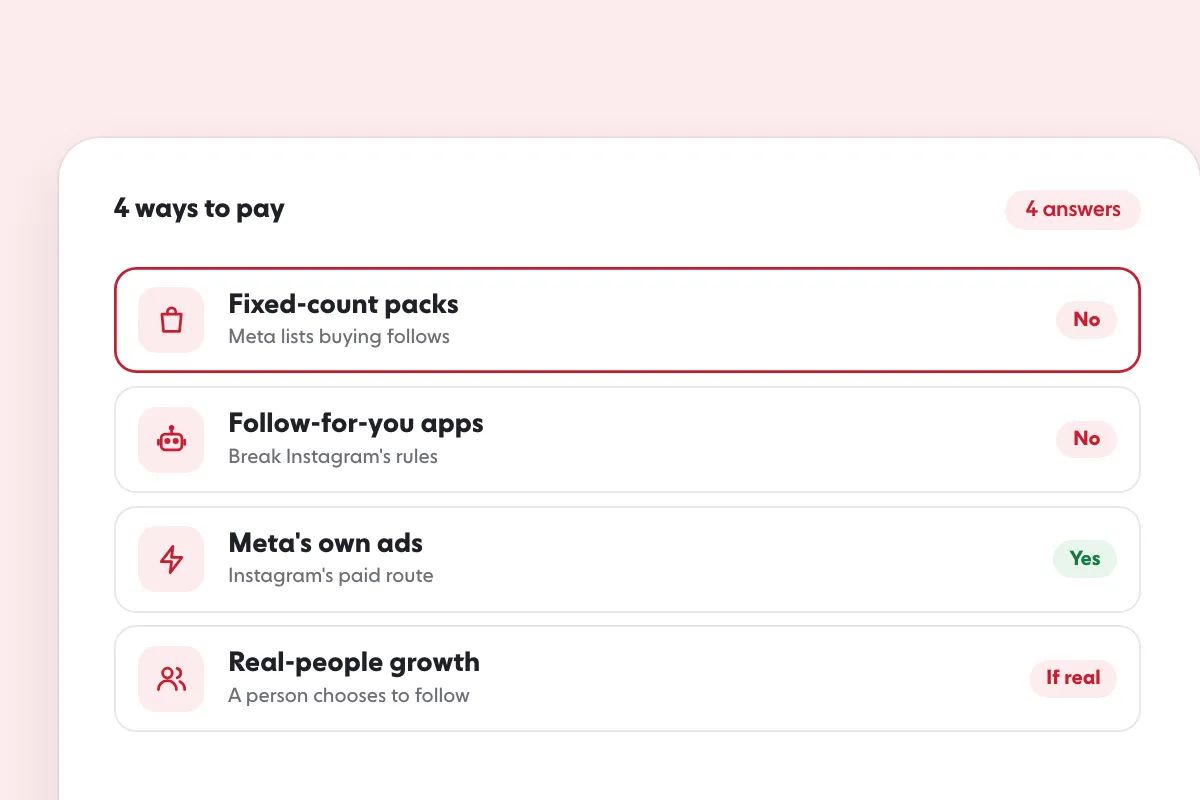
For the rule sets in full, read Can You Buy Instagram Followers? 4 Ways to Pay, 4 Answers. For a checklist of what to ask a seller, see Buy Instagram Followers: Real vs Fake and 7 Checks.
What would a real headcount need?
It would need either the platform’s own data or a survey of buyers with a clear method. In our reading, only the platform can see where an account’s follows came from, while researchers outside it see catalogues and prices. A survey of account owners would measure what people are willing to say, and the SRF authors say they cannot confirm purchase from the outside.
Until one exists, the careful sentence is the one the evidence supports: there is a large, cheap and competitive market for fake followers, a share of the followers of one group of Swiss influencers in 2017 looked fake, and nobody we could cite knows what share of Instagram accounts have bought any.
What should you take from this?
Two things. First, the question that matters for your account is not how many other people buy, but what a bought count would do to you, and the rules and results are covered in the pages linked above. Second, if you want followers who chose to follow, the route that does not involve a seller of fake accounts is a service whose followers are real people who chose to follow. SocialCaptain asks for a public username, never a password, matches real people to your niche, country and language, and carries a 14-day money-back promise on the first payment. As read on 19 November 2026, first-payment prices on the pricing page are $27.99 a month on Starter and $39.99 a month on Pro on the 6-month plan, and $47.99 and $68.99 month to month. To compare services on the same points, use best Instagram growth services.
FAQ
Do people buy Instagram followers?
Yes. A 2023 study by researchers at Universidad Carlos III de Madrid and IMDEA Networks found more than fifty resale panels selling fake interactions, with a median listing of $4.62 per 1,000 Instagram followers (2020 data). Listings show supply. They do not show how many people buy.
How many people buy Instagram followers?
No source we opened gives a number. The IMDEA Networks news item on the 2023 study says the total volume of fake interactions on current platforms is unknown. We found no primary figure for the share of Instagram accounts that bought followers, so we give none.
Why do people buy Instagram followers?
The sources name three aims: influencers promoting their channels, brands promoting the visibility of their products, and affecting what other people pay attention to, buy or sponsor. Low prices and free trials make it easy to try. Those last two are our reading of the study facts.
What percent of Instagram followers are fake?
There is no figure for Instagram as a whole in the sources we opened. A 2017 SRF Data investigation classified between 25.8% and 31.1% of about 7 million followers of 115 Swiss influencers as fake, with a median influencer at 14.3% to 19.6%. That is one country and one year.
Are most influencers’ followers bought?
The sources we opened do not say so. The SRF Data authors state that they cannot confirm whether the fake followers they found were bought by the influencers themselves. They suspect that some influencers with 25% to 75% fake followers procured them, and say they have no proof.
Does a low price mean many people buy?
Not by itself. The 2023 study reports a median of $4.62 per 1,000 followers listed (2020 data), and IMDEA’s authors read the wide gaps between providers as a sign of a developing market in which the value of the service is unknown. Neither the price nor the number of listings counts buyers.
Sources
- A study analyses fake interaction services on social media networks.imdea.org
- An analysis of fake social media engagement services doi.org
- Removing Fake Likes, Follows & Comments about.instagram.com
- Attorney General James announces settlement with sellers of fake followers and likes (30 January 2019) ag.ny.gov
Related guides
Growth services
Buy Instagram Followers: Real vs Fake and 7 Checks
Growth services
Can You Buy Instagram Followers? 4 Ways to Pay, 4 Answers
Growth services
What Happens When You Buy Instagram Followers: 5 Stages
Written by Jonas Revel
Research editor
Jonas Revel runs research on the SocialCaptain blog: the statistics pages, account safety, and the fact-check every article gets before it goes live. Each number is traced to its original source and dated, and figures that cannot be traced are left out.
All articles by Jonas Revel


