What Happens When You Buy Instagram Followers: 5 Stages
Quick answer
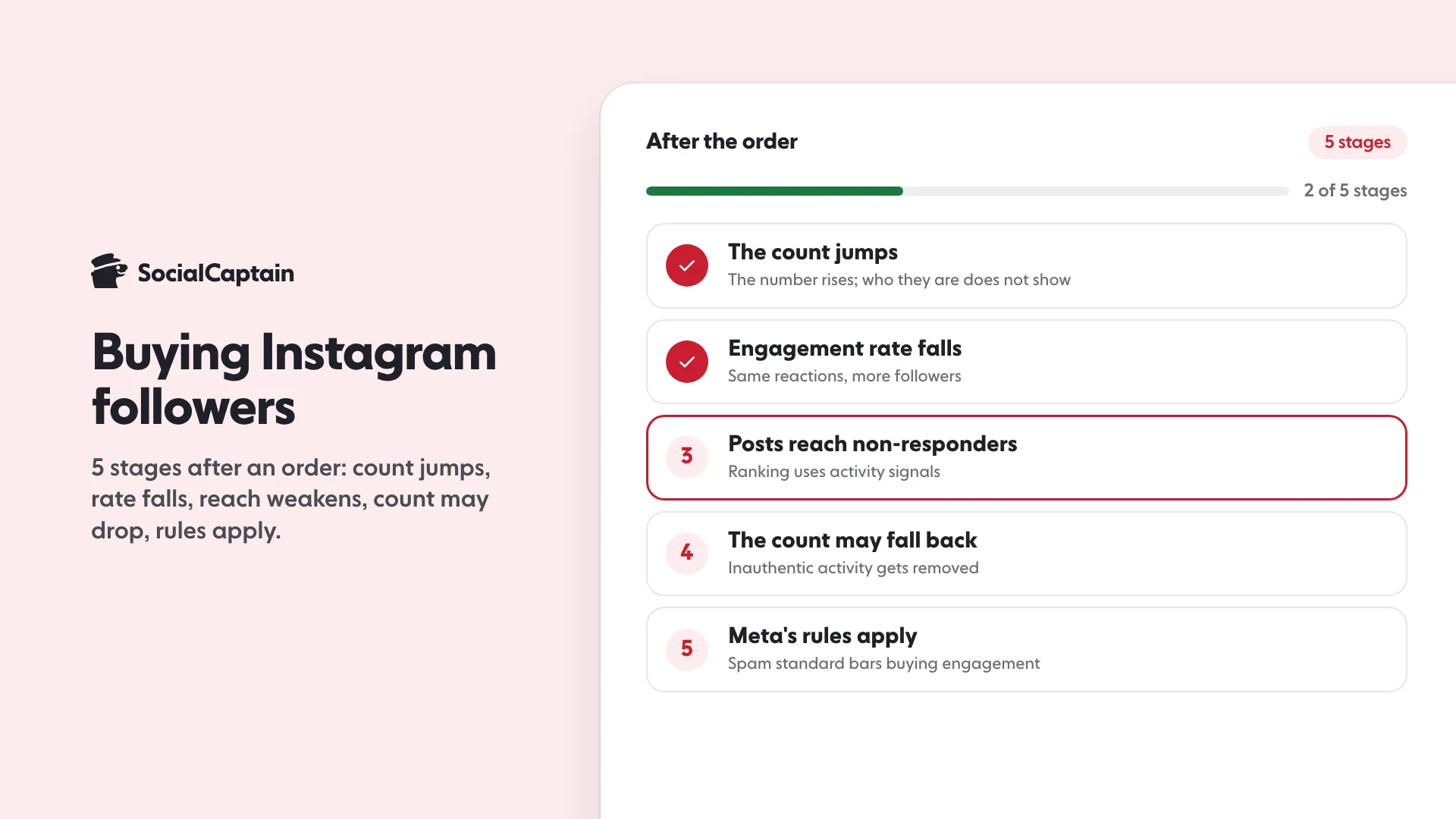
Five stages, in order: your follower count jumps, your engagement rate falls, your posts reach accounts that never respond, your count may fall back, and Meta's spam rules and the FTC rule on fake followers apply. Instagram publishes no timings for any stage.
- Engagement rate falls when new followers never respond.
- Meta's spam standard bars buying engagement.
- The FTC rule needs knowledge and a commercial purpose.
On this page11 sections
Buying Instagram followers plays out in 5 stages: your count jumps, your engagement rate falls, your posts reach accounts that never respond, your count may fall back later, and Meta’s spam rules and the FTC rule on fake followers apply. Instagram publishes no timings for any stage, so this guide orders them by what you see and gives no days or percentages it cannot source. Where a figure appears, it is a worked example and says so.
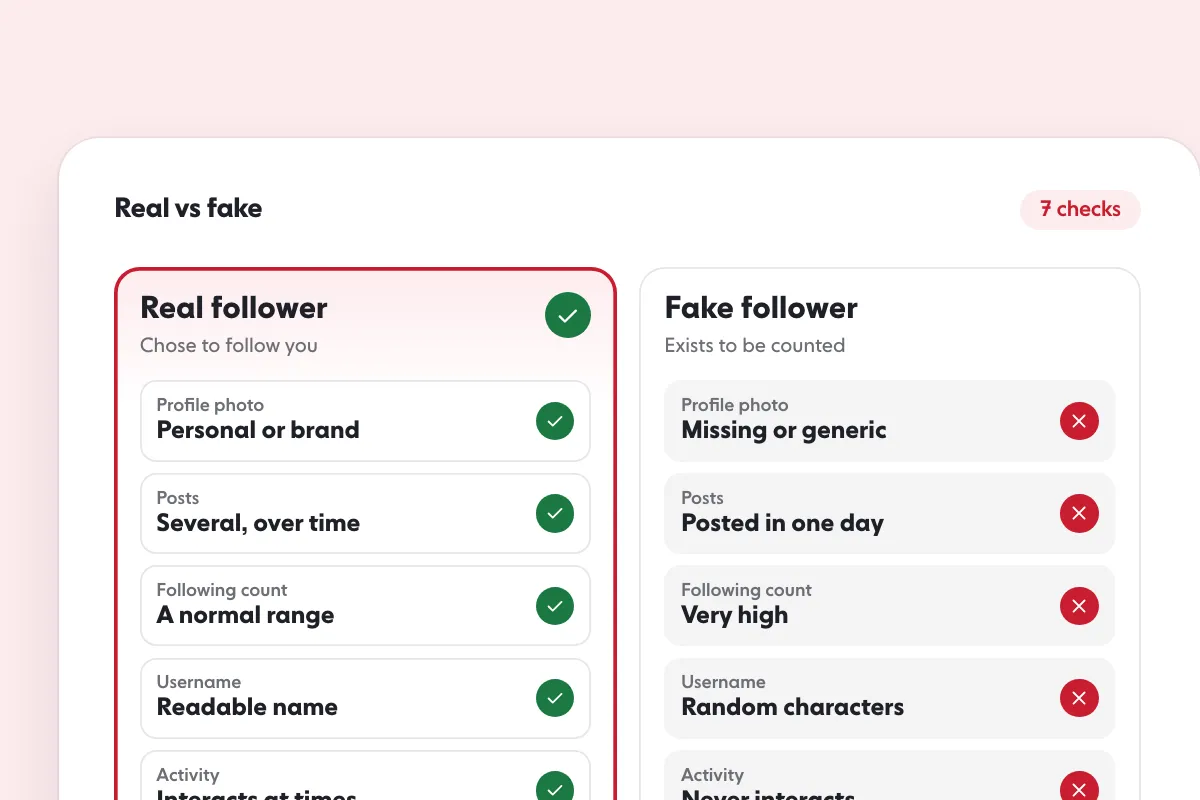
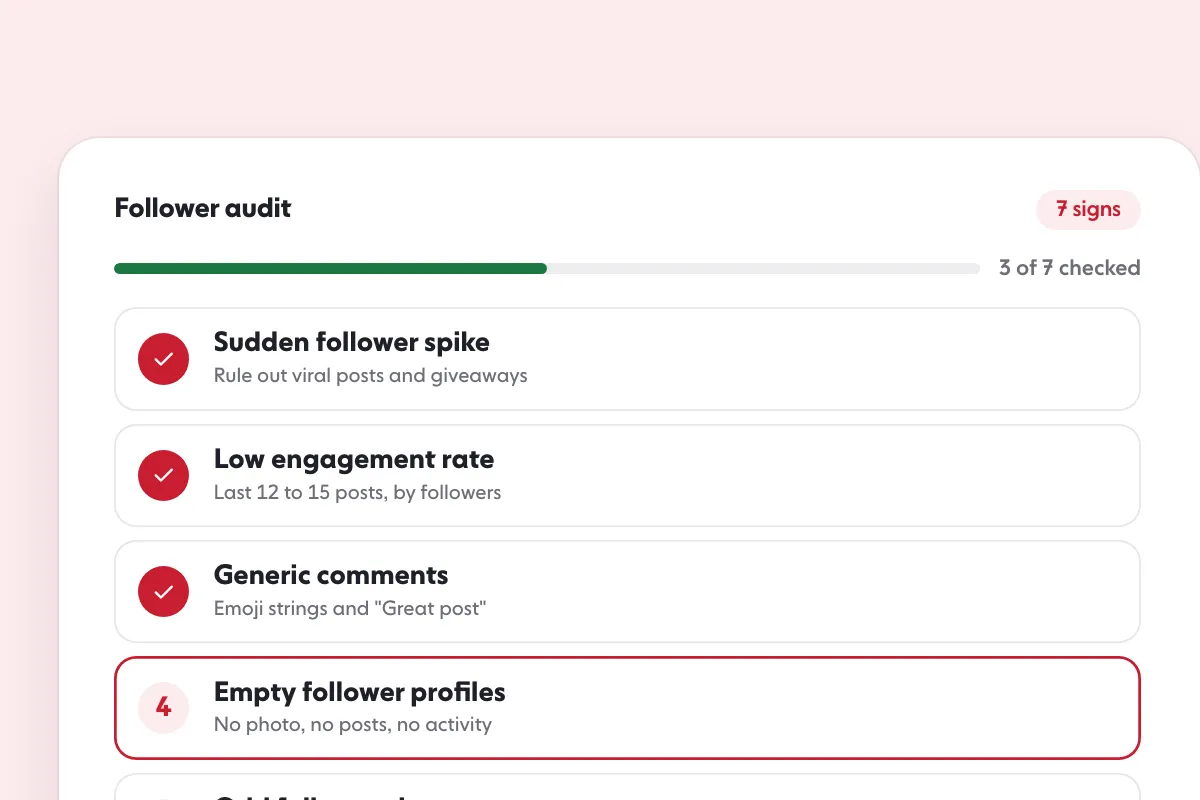
It does not repeat two things its neighbours cover. How to judge a seller before you pay is in buy Instagram followers: real vs fake and 7 checks, which also tracks followers over 30 days. How to tell whether someone else bought followers is in how to check if someone bought Instagram followers. This page follows one order from the moment you pay.
What are the 5 stages after you buy followers?
| Stage | What you see | What Instagram’s pages say |
|---|---|---|
| 1. The count jumps | A bigger follower number on your profile | Nothing about the count itself |
| 2. Engagement rate falls | The same likes and comments, spread over more followers | Not a stated rule; it is arithmetic |
| 3. Posts reach non-responders | Fewer reactions to build on | Ranking uses activity and interaction signals |
| 4. The count may fall | Followers disappear, sometimes in a batch | Inauthentic activity from third-party apps is removed |
| 5. Rules apply | Possible warnings, restrictions or a disabled account | Meta’s spam standard bars buying engagement |
The order is the order a typical buyer meets them, not a schedule. Stage 4 can come before stage 3 becomes obvious, and stage 5 is a risk, not a certainty. The sections below go through each one.
Stage 1: what do you see right after the order?
Your follower number rises. That is the only part of the order that is fully visible and fully under the seller’s control, and it is the one every seller sells.
What you cannot see yet is who the new followers are. A real follower is a person with an active account who chose to follow you. A fake follower is an account that exists only to be counted. The number looks the same either way. The difference shows in the next stages, in how many of them ever like, comment or watch.
Brands and other creators can look for the same gap you will, which is why the signs of bought followers are a topic of their own.
Stage 2: why does your engagement rate fall?
Engagement rate divides interactions by an audience size. Add followers who never interact and the top number stays where it was while the bottom number grows.
Here is a worked example, with made-up numbers, not a measured result. A post gets 80 likes and comments, and the account has 2,000 followers: 80 divided by 2,000 is 4 percent. Add 3,000 accounts that never respond. The same post still gets about 80 interactions, now over 5,000 followers: 80 divided by 5,000 is 1.6 percent. You did not lose a single real fan, and the rate still fell by more than half.
The formula is yours to choose. Some people divide by followers, others by reach. The point is that any version that divides by followers is pulled down by followers who do not respond. How to calculate Instagram engagement rate shows the common formulas, and what a good engagement rate is shows how to read the result.
Stage 3: what does it do to the reach of your posts?
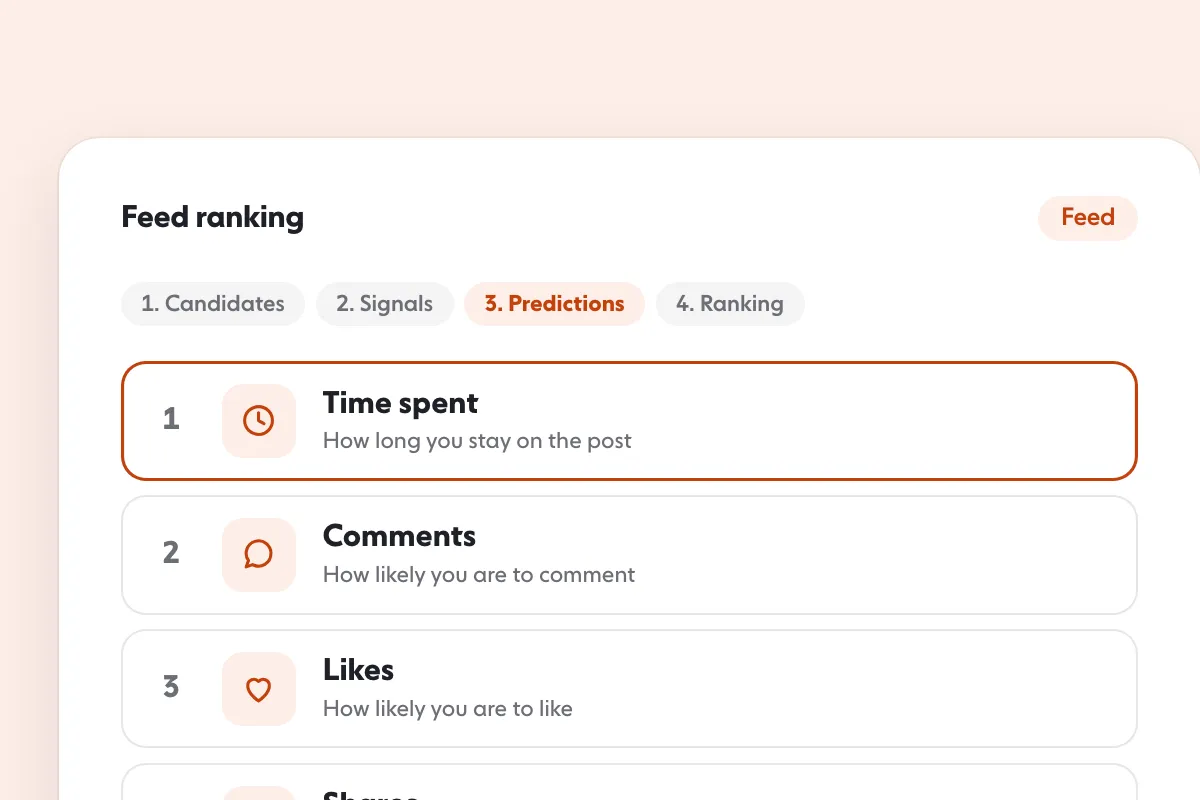
Instagram’s page “Instagram Ranking Explained”, published May 31, 2023, lists the signals it uses to order what you see. For Feed it names, in rough order of importance: “Your activity”, “Information about the post”, “Information about the person who posted” and “Your history of interacting with someone”. It adds that “there are thousands of them”.
Two things follow, and only the second needs care.
First, most of those signals are about interaction. A follower who never likes, comments or watches adds no interaction to build on. This is a reading of the page, not a quote from it, and the page does not describe bought followers. It does name follower count in one place: for Reels, among the signals about the person who posted, it says “We consider popularity signals such as number of followers or level of engagement”. The page gives no weights, so this guide draws no conclusion from it about a bought count.
Second, where your post appears depends on the surface. The page says Feed is “a mix of content from the accounts you’ve chosen to follow, recommended content from accounts we think you’ll enjoy and ads”. For Reels it says “the majority of what you see is from accounts you don’t follow”. So a large follower number is not the only route to an audience. A Reel can be shown to people who do not follow you.
The practical effect for a buyer is that the number on the profile and the number of people reached can drift apart. If you want to see that gap on your own account, write down your follower count and the reach of your last 10 posts each week. For the full ranking picture, read the Instagram algorithm guide.
Stage 4: can the count fall back later?
Yes, and for several reasons. Instagram says it removes inauthentic activity, and a followers number can also fall for ordinary reasons such as people unfollowing.
Instagram’s post on reducing inauthentic activity, dated November 19, 2018, says it will begin removing inauthentic likes, follows and comments from accounts that use third-party apps. It says it has “built machine learning tools” to identify those accounts, and that the apps “violate our Community Guidelines and Terms of Use”. The post covers activity those accounts give to others. It does not say that followers a customer bought are removed, and it gives no rate. So a falling count is consistent with removal, but the post alone does not prove it.
A 2014 research paper on purchased followers on Twitter, a different platform, found that the accounts show a very high unfollow entropy rate and low social engagement, and that the markets it studied did not honor the service policies and guarantees they offered. That study is old and about another service, so it is not a forecast for Instagram. It is a reason to be wary of a refill promise as a safety net.
Whatever the cause, an unexplained drop right after an order is the sign to look at. Why am I losing Instagram followers lists 9 causes and how to tell them apart.
Stage 5: what do Meta’s rules say about buying followers?
Meta’s Community Standards “outline what is and isn’t allowed on Facebook, Instagram, Messenger and Threads”. Its spam standard says “We do not allow content that is designed to deceive, mislead, or overwhelm users in order to artificially increase viewership.” Among the behaviors it lists is “selling, buying, or exchanging for engagement, such as likes, shares, views, follows, clicks”, and it lists high-frequency activity done manually or automatically.
That is the rule. The penalty side is general. Meta describes a three-part approach to enforcement on Facebook and Instagram: “remove, reduce and inform”. On strikes, it says it may apply one to a “Facebook or Instagram account” when it removes violating content, and that “All strikes on Facebook or Instagram expire after one year”. On disabling, it says it will disable an account if a person keeps posting violating content “despite repeated warnings and restrictions”, and that serious violations can lead to a disabled account after one occurrence.
What the pages do not say is how much any of this applies to a purchase of followers. No page I opened gives a number of followers, a kind of order or a number of orders that leads to a strike, a restriction or a disabled account. Treat anyone who quotes such a number as guessing.
One more point from the 2018 post. Instagram says accounts that keep using such apps “may see their Instagram experience impacted”, and that flagged accounts receive an in-app message. It also says people who use these apps share their username and password, and that changing the password revokes an app’s access. If a seller ever asked for your login, change your password. Instagram shadowban: 5 signs, how to check and 6 fixes shows how to read your account’s status if you think something was limited.
What about the law?
The FTC announced a final rule in August 2024 that “prohibits anyone from selling or buying fake indicators of social media influence”. The rule text, 16 CFR 465.8, says it is an unfair or deceptive act or practice to “Purchase or procure fake indicators of social media influence that they knew or should have known to be fake and that materially misrepresent their influence or importance for a commercial purpose”.
Read the conditions together:
- Fake: the rule’s definition covers indicators generated by bots, accounts not associated with a real individual, accounts created with a real person’s information without consent, and hijacked accounts, or that otherwise do not reflect a real individual’s or entity’s activities.
- Knew or should have known: a buyer who was unaware is not the target; one who ought to have known may be.
- Commercial purpose: the misrepresentation must be about influence or importance for a commercial purpose.
The indicators the rule lists include followers, views, likes, saves, shares and comments. The FTC enforces it and says it can seek civil penalties against knowing violators. This is a US rule, and this guide draws no legal conclusion from it for your case. For a business account, the plain point is that numbers shown to sponsors and customers are what the rule is about.
What should you do before and after an order?
A short plan, in the order to do it.
- Record a baseline. Before any order, note your follower count, your engagement rate and the reach of your last 10 posts.
- Never share your login. Instagram’s 2018 post ties the use of third-party apps to sharing a username and password.
- Ask who the followers are. Real people who match your niche, country and language are the only version that is not an inflated number. The 7 checks turn that into questions for a seller.
- Record again each week. Use the same measures. The question is whether real reactions grew with the count.
- Watch for a drop. If your count falls in a batch, start with the causes in why am I losing Instagram followers.
- Do not use the numbers to mislead. If you show your followers to a sponsor, the FTC rule is about misrepresenting influence for a commercial purpose.
How is buying followers different from a growth plan?
Buying a number gives you a count and nothing else. A growth plan that sells real people who match your niche, country and language is aimed at an audience instead of a count. That is the honest contrast, and it does not change what Instagram’s rules say: the platform decides what counts as inauthentic, and no seller can promise its ruling.
If you want to compare services on criteria rather than promises, the best Instagram growth services page ranks seven on seven points. The Instagram followers page explains the service SocialCaptain sells, and the Instagram growth service guide explains how such services work.
SocialCaptain has two plans, Starter and Pro. The first payment on the 6-month plan is $27.99 a month for Starter and $39.99 a month for Pro. The monthly plan is $47.99 for Starter and $68.99 for Pro. The first payment carries a 14-day money-back guarantee. See pricing for what each includes.
For how common buying is and why no source counts it, read Do People Buy Instagram Followers? 2 Studies, No Headcount. For what the law says about a purchase, read Is It Illegal to Buy Instagram Followers? 1 US Rule, 5 Parts. If an account is disabled, Instagram Account Suspended: 6 Causes and How to Appeal walks through the appeal.
FAQ
What happens when you buy Instagram followers?
Five things, in order. Your count rises, your engagement rate falls if the new accounts never respond, your posts get less response to build on, your count may fall later, and Meta’s spam rules and the FTC rule on fake followers apply. Instagram publishes no timings for any of these.
Does Instagram ban you for buying followers?
Instagram’s pages do not say buying followers alone gets an account banned. Meta’s spam standard bars buying engagement, and its enforcement pages describe warnings, restrictions and disabling after repeated violations. They do not tie a purchase to a specific penalty.
Will bought Instagram followers disappear?
They can. Instagram’s 2018 post says it removes inauthentic likes, follows and comments given by accounts that use third-party apps. It does not say it removes followers an account bought, and it publishes no drop rate. A falling count after an order is a sign to check, not a proof.
Can Instagram tell you bought followers?
Instagram does not say how it detects them. It says it has built machine learning tools to identify accounts that use third-party apps for inauthentic activity. Anyone judging your account can also compare your reach with your count.
Will buying followers hurt your engagement rate?
It can. Engagement rate divides interactions by followers, so accounts that never respond lower it, as the worked example in this guide shows. The example is arithmetic, not a measured result.
When does the FTC rule apply to bought followers?
Only when the buyer knew or should have known the followers were fake and they materially misrepresent influence for a commercial purpose. That is the scope of the FTC’s 16 CFR 465.8 on buying fake indicators of social media influence; it is not a blanket ban.
Sources
- Spam transparency.meta.com
- Community Standards transparency.meta.com
- Meta enforcement: taking action transparency.meta.com
- Meta enforcement: counting strikes transparency.meta.com
- Disabling accounts transparency.meta.com
- Removing Fake Likes, Follows & Comments about.instagram.com
- Instagram Ranking Explained about.instagram.com
- FTC final rule banning fake reviews and testimonials (press release) ftc.gov
- 16 CFR Part 465 law.cornell.edu
- Followers or Phantoms? An Anatomy of Purchased Twitter Followers (arXiv, 2014) arxiv.org
Related guides
Growth services
Buy Instagram Followers: Real vs Fake and 7 Checks
Growth services
How to Check If Someone Bought Instagram Followers: 7 Signs
Algorithm and reach
Instagram Algorithm 2026: 5 Ranking Signals Explained
Written by Jonas Revel
Research editor
Jonas Revel runs research on the SocialCaptain blog: the statistics pages, account safety, and the fact-check every article gets before it goes live. Each number is traced to its original source and dated, and figures that cannot be traced are left out.
All articles by Jonas Revel


