Should a Business Buy Instagram Followers? 3 Rules, 4 Risks
Quick answer
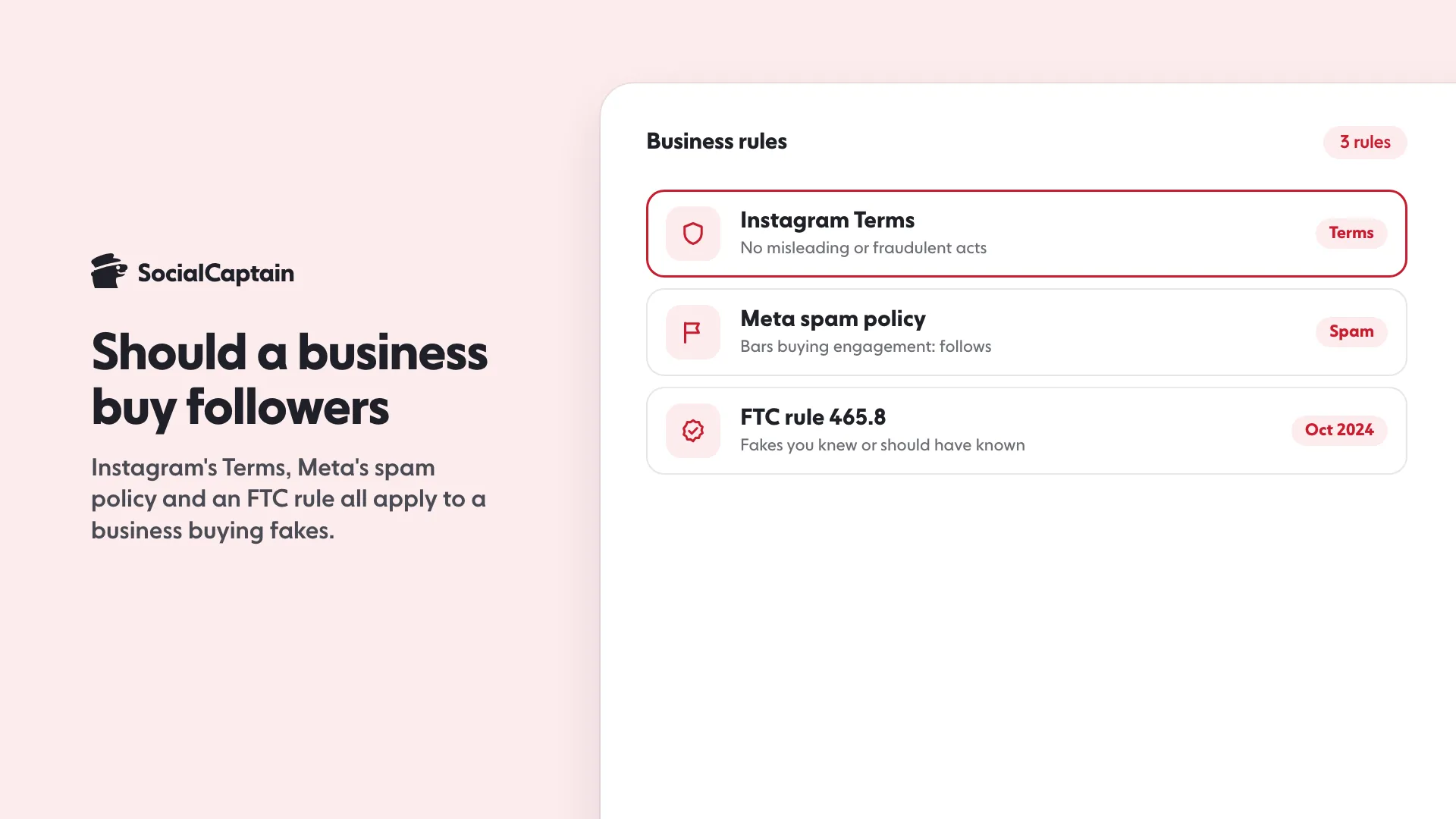
A business should not buy fake Instagram followers. Instagram's Terms, Meta's spam policy and FTC rule 16 CFR 465.8 apply. Followers can be removed, the account limited or disabled, a login exposed, and FTC rules cover buyers who knew or should have known.
- Meta's spam policy bans buying engagement such as follows.
- FTC rule 465.8 took effect on October 21, 2024.
- FTC Q&A: followers won through influencer recommendations are real people who chose to follow.
On this page8 sections
A business should not buy fake Instagram followers. Three sets of rules stand in the way: Instagram’s Terms of Use, Meta’s spam policy, and the US Federal Trade Commission’s rule on fake indicators of social media influence, 16 CFR 465.8. Buying them carries 4 risks: removed followers, a limited or disabled account, login details handed to a stranger, and exposure under the FTC rule. This guide covers the 3 rules, the 4 risks, what it means for ads and brand partnerships, and what a business can do instead. The answer changes when the followers are real people who chose to follow, so that line comes first.
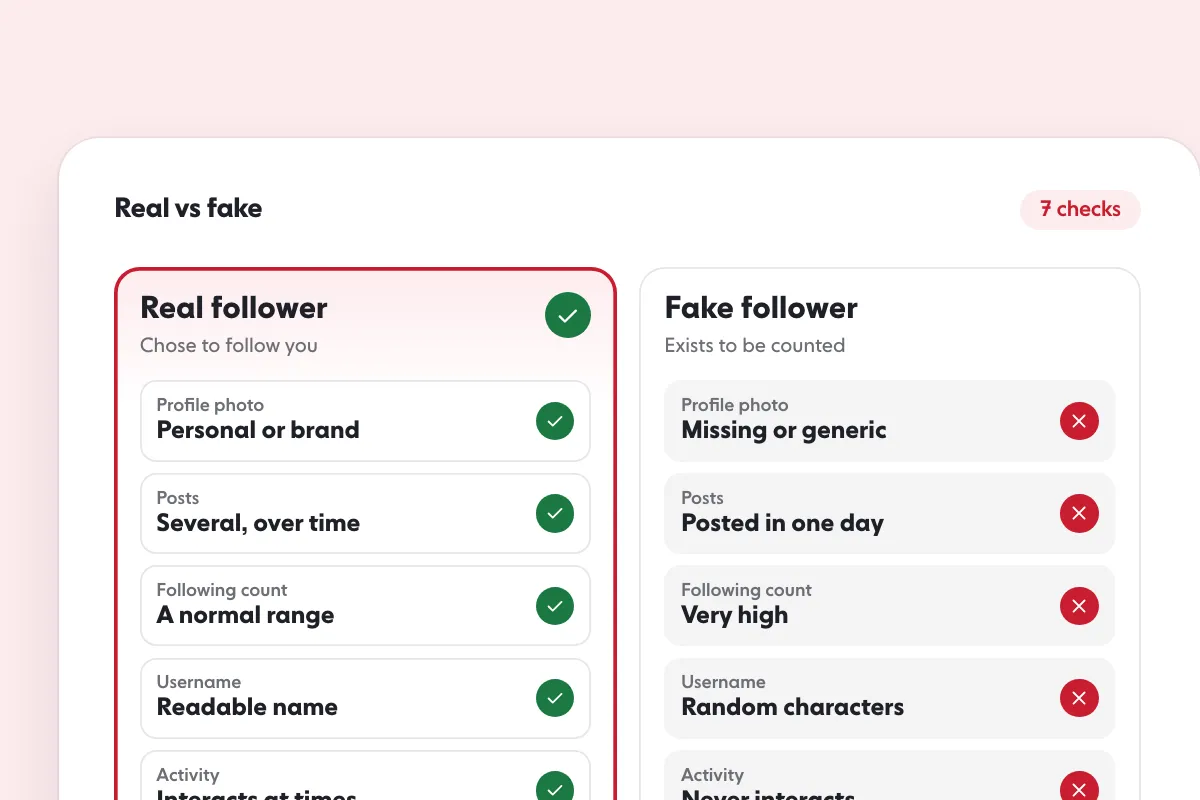
This page is about the business decision and the rules around it. For the tests that separate real from fake followers, read Buy Instagram Followers: Real vs Fake and 7 Checks.
Should a business buy Instagram followers at all?
Buying a number is the wrong goal. Buying reach among people who might become customers is a different goal, and it is the one a business has. The two get called the same thing, “buying followers”, which is why the answer needs a split.
| Fake followers | Real followers reached through targeting | |
|---|---|---|
| Who they are | Bots, empty or hijacked accounts, accounts not tied to a real person | Real people who chose to follow |
| Instagram’s view | Inauthentic activity it removes | Not described separately in the pages cited here |
| FTC rule 465.8 | The rule’s definition of fake indicators covers them | The FTC Q&A treats followers won through influencer recommendations as real people who chose to follow; it does not address growth services |
| Does it help a business | A bigger number that does not buy, comment or share | A smaller audience that can |
The FTC row comes from its own question-and-answer page. It says that followers gained through influencers recommending your account are not fake indicators, answering “No, because these followers are real people who chose to follow the business account.” That answer is about influencer recommendations. The page does not address paid growth services, so it does not rule on any service.
SocialCaptain sells the second column: real people from the customer’s niche, country and language. Every rule below is read for what it says about the first column and about the act of paying for engagement.
Which 3 rules apply to a business that buys followers?
Three documents matter. Each one is quoted below from the page as it reads today.
1. Instagram’s Terms of Use
The Terms list what you cannot do on Instagram. None of them mentions buying followers, so read these three lines as the closest the Terms come, not as a ruling on a purchase:
- “You can’t do anything unlawful, misleading, or fraudulent or for an illegal or unauthorized purpose.”
- “You can’t sell, license, or purchase any account or data obtained from us or our Service”. The next line says this “includes attempts to buy, sell, or transfer any aspect of your account (including your username)”.
- You also cannot create accounts or collect information “in an automated way without our express permission”.
The Terms also say Instagram can stop providing the service, including “terminating or disabling your access”, if you violate the Terms or its policies, which include the Community Standards. What the Terms give Instagram is a wide right to act on an account that breaks the rules. Instagram’s 2018 announcement is more specific: it says that third-party apps that generate “inauthentic likes, follows and comments violate our Community Guidelines and Terms of Use.”
2. Meta’s spam policy
The Community Standards apply across Meta’s products, and the Instagram Terms point to them. The spam policy opens with a statement of purpose: “We do not allow content that is designed to deceive, mislead, or overwhelm users in order to artificially increase viewership.”
It then lists what it does not allow. One item is “Attempting to or successfully selling, buying, or exchanging for engagement, such as likes, shares, views, follows, clicks, use of specific hashtags, etc.”
That is the most direct line of the three for a business, because it names follows. The exceptions the page lists are cross promotion not triggered by payment to a third party, admin transfers based on interest rather than an exchange of value, and clearly identified Branded Content. A paid follower service is not among them. The page does not say how any particular service is treated.
3. The FTC rule, 16 CFR 465.8
The FTC’s Rule on the Use of Consumer Reviews and Testimonials is mostly about fake reviews. One section, 465.8, is about followers and other metrics. The Federal Register notice of the final rule is dated August 22, 2024, and the rule took effect on October 21, 2024. The text of § 465.8 reads:
It is an unfair or deceptive act or practice and a violation of this part for anyone to: (a) Sell or distribute fake indicators of social media influence that they knew or should have known to be fake and that can be used by individuals or businesses to materially misrepresent their influence or importance for a commercial purpose; or (b) Purchase or procure fake indicators of social media influence that they knew or should have known to be fake and that materially misrepresent their influence or importance for a commercial purpose.
Two definitions in § 465.1 tell you what is covered. “Indicators of social media influence” means “any metrics used by the public to make assessments of an individual’s or entity’s social media influence, such as followers, friends, connections, subscribers, views, plays, likes, saves, shares, reposts, and comments.” “Fake indicators” are those generated by bots, “purported individual accounts not associated with a real individual”, accounts made with a person’s information without consent, or hijacked accounts, or that “otherwise do not reflect a real individual’s or entity’s activities, opinions, findings, or experiences.”
Note the limits the text sets on the buyer side. Paragraph (b) applies when the buyer knew or should have known the indicators were fake, and when they materially misrepresent influence or importance for a commercial purpose. The FTC’s press release describes the same limit. This page reports what the rule says and who enforces it. It does not say whether any particular purchase breaks it.
What are the 4 risks for a business?
Risk 1: the followers disappear
Instagram says it removes activity from inauthentic accounts. Its help page on changes to likes, follows and comments says that some of these changes “may be because some came from accounts generating inauthentic activity”, and that “We routinely remove disabled accounts to keep Instagram safe”, which can change a follower total “even within a short time”.
In November 2018 Instagram announced it would begin “removing inauthentic likes, follows and comments from accounts that use third-party apps to boost their popularity”, and said it had built machine learning tools to identify them. For a business the practical meaning is simple: money spent on a count that Instagram later reduces leaves you with the cost and not the count.
Risk 2: a limited or disabled account
Instagram’s page “Why you should not use apps that offer likes and followers on Instagram” is blunt. It says: “You shouldn’t use apps that offer likes and followers.” It adds that accounts that keep using such apps “may notice that certain parts of their Instagram account are limited”, and that “If you use one of these apps to gain likes or followers, your account may be disabled or terminated.”
For a business the account is the asset. If the account is disabled or terminated, the business loses the place where its posts and audience sit. The page says “may”, not “will”, and it does not describe how Instagram decides. It is still a clear warning from the platform that owns the account.
Risk 3: you hand your login to a stranger
Some sellers of followers ask for a username and password or an access token. Instagram’s page says that if you give those, such apps “can gain complete access to your account”. They can see private messages and “potentially post spam or other harmful content on your profile.” For a business that includes customer conversations.
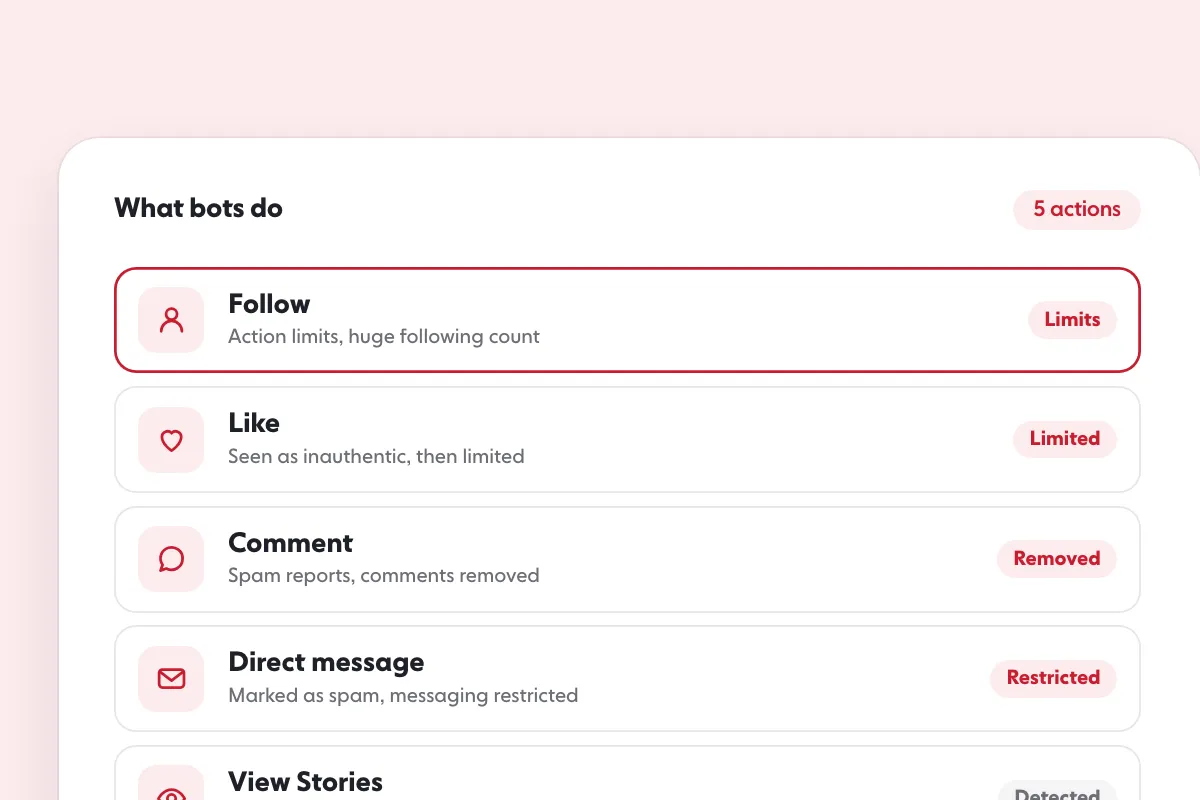
Never share a password with a follower seller. Our guide to Instagram bots explains the risks of each type of bot.
Risk 4: exposure under the FTC rule
If the followers are fake, the FTC rule is a separate risk from the platform’s. What the rule says about the business side is narrow: the buyer must have known or should have known the indicators were fake, and the misrepresentation must be material and for a commercial purpose.
The FTC Q&A gives two examples a business owner will recognize. First, a business pays a third party to run a promotional campaign for followers, and the vendor secretly supplies fake followers. The FTC says that provision “is limited to the purchase of fake indicators of social media influence which you knew or should have known to be fake”, and “you wouldn’t be liable unless there were some red flags that should have tipped you off.” Second, hiring influencers who happen to have fake followers is not covered by this provision.
On penalties, the FTC says the rule “authorizes courts to impose civil penalties for knowing violations”, and the Federal Register notice says that a civil penalty requires “actual knowledge or knowledge fairly implied on the basis of objective circumstances”. The FTC adds that the rule “does not provide a private right of action”, so the agency is the enforcer.
Red flags are the practical lesson, and the FTC does not publish a list of them. Our own warning signs are followers that arrive in a day, accounts with no photo and a random username, and a seller that cannot say where the followers come from. The checks for them are in How to Check If Someone Bought Instagram Followers: 7 Signs.
What does it mean for ads and brand partnerships?
The FTC rule defines the numbers a brand might look at as “any metrics used by the public to make assessments” of influence. A business that sells to other businesses, a creator who sells sponsored posts and an agency that pitches an audience all use a follower count as a claim about reach.
Two other points from the sources are worth knowing:
- The FTC Q&A says ad agencies, PR firms and similar companies are not immune from liability under the rule, and names § 465.8 as one place where they could be liable “if they misuse fake or false indicators of social media influence”.
- Instagram’s branded content policy defines branded content as content that “features or is influenced by a business partner for an exchange of value, such as monetary payment or free gifts”, and requires the branded content tool plus “all necessary disclosures” under applicable law. If your partnerships depend on an audience, that audience needs to be real people.
Your own audience data sits in Instagram Insights, which any public account can open. It shows top locations, age range and times followers are most active, and splits the accounts engaged on a post into followers and non-followers. If you pitch partners, these are the numbers worth checking first: compare the headline follower number with the accounts engaged on your recent posts, because a large gap is what a partner is likely to notice. How to read those screens is covered in Instagram Insights: 9 Metrics to Track.
What can a business do instead of buying followers?
Aim at the thing the number was a proxy for: people who might buy, and proof that they exist. These are the options, in the order most small businesses should try them.
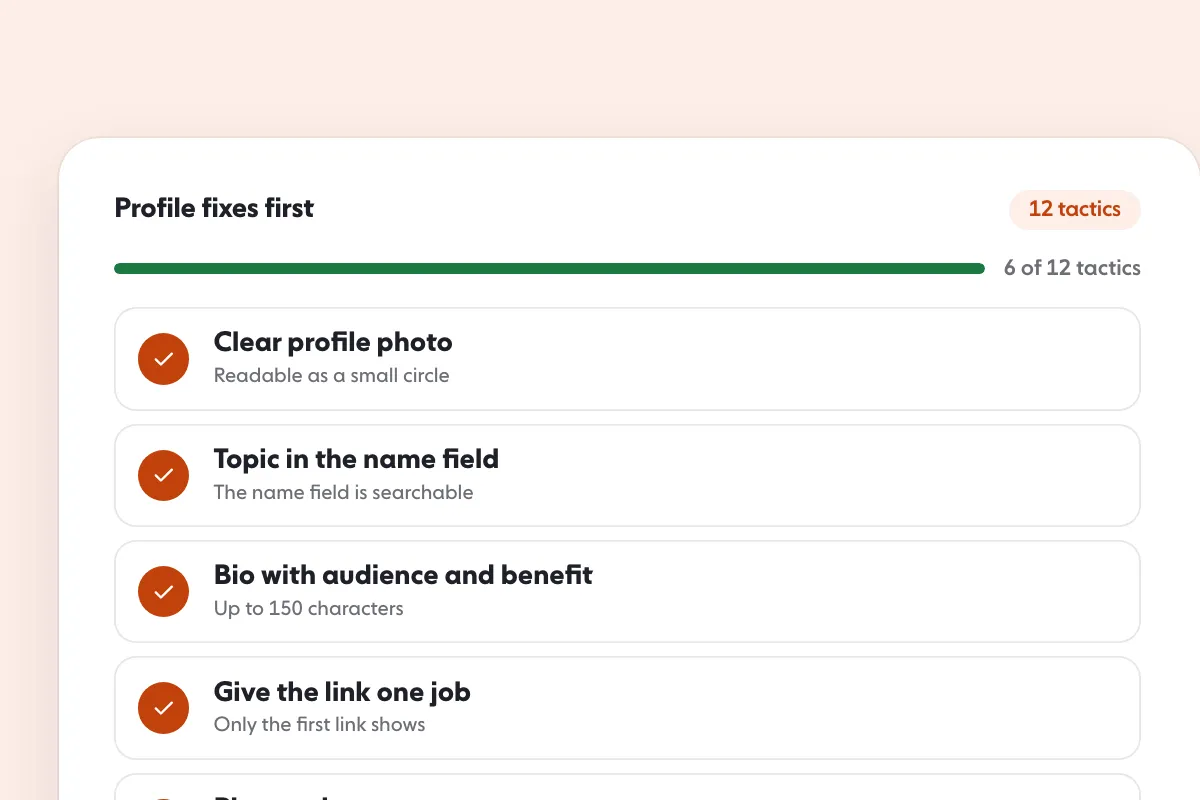
- Fix the profile first. Start with what a visitor sees first. How to Get More Instagram Followers: 12 Tactics That Work lists the profile and content changes that turn visits into follows.
- Pick one niche and post to it. Followers who came for a clear subject are more likely to engage than followers from everywhere.
- Work with accounts your customers already follow. The FTC Q&A names this case: followers who arrive because an influencer recommended the account are “real people who chose to follow”.
- Run ads for reach. Instagram’s help page says boosting content is available to professional (business or creator) accounts, and ad insights then show results for the ad.
- Measure with Insights, not with the follower count. Followers gained and lost, top locations and accounts engaged show whether the audience is the one you wanted.
- If you use a paid service, check what it sells. A growth service whose followers are real people from your niche, country and language is a growth method, not a follower count. Our Instagram growth service page is the plain link, and How Instagram Growth Services Work: 5 Methods Explained covers the methods. The criteria for comparing providers are in Best Instagram Growth Services.
Before paying any provider, use this list. It is a set of questions to ask, not a legal test:
- Does it ask for your password? If yes, stop.
- Can it say where the followers come from?
- Is the pace slow enough to look like an account growing?
- Can you choose the audience by niche, country and language?
- Can you stop at any time?
- Does it promise a fixed number by a fixed day?
A “no” on 2 to 5, or a “yes” on 1 or 6, is a warning sign by our own reading. It is not a test the FTC publishes.
What does SocialCaptain offer a business?
SocialCaptain does not sell bots or fake accounts. It sells followers who are real people from the customer’s niche, country and language. See Instagram followers.
Plans are Starter and Pro. On the 6-month plan the first payment works out to $27.99 a month for Starter and $39.99 a month for Pro. On the monthly plan it is $47.99 for Starter and $68.99 for Pro. Every first payment has a 14-day money-back guarantee. Current plans are on pricing.
For the buyer’s own risks, read Is It Safe to Buy Instagram Followers? No: 4 Buyer Risks, and for whether the count is worth buying, read Is Buying Instagram Followers Worth It? 5 Goals, 5 Verdicts.
FAQ
Should a business buy Instagram followers?
Not fake ones. Followers from bots or fake accounts fall under Instagram’s Terms of Use and Meta’s spam policy, and the FTC’s rule 16 CFR 465.8 covers buying fake indicators of social media influence when the buyer knew or should have known they were fake. Real people who chose to follow your account are a different thing.
What does the FTC rule say about buying followers?
Section 465.8 makes it an unfair or deceptive practice to purchase or procure fake indicators of social media influence that you knew or should have known to be fake and that materially misrepresent your influence or importance for a commercial purpose. The rule took effect on October 21, 2024.
Can the FTC fine a business for buying fake followers?
The FTC says its rule authorizes courts to impose civil penalties for knowing violations. The Federal Register notice adds that penalties require actual knowledge or knowledge fairly implied. The rule gives no private right of action, so enforcement sits with the FTC. This page does not give legal advice.
What if a growth vendor delivered fake followers without telling me?
The FTC’s own question-and-answer page covers this case. It says the provision is limited to purchases you knew or should have known were fake, and that you would not be liable unless there were red flags that should have tipped you off.
Will Instagram punish an account that buys followers?
Instagram’s help pages say it removes inauthentic activity, that accounts using apps to get more followers may find parts of their account limited, and that such an account may be disabled or terminated. It does not publish exact penalties for each case.
What should a business do instead of buying followers?
Build an audience of real people: fix the profile, post content that fits one niche, work with accounts your customers already follow, run ads for reach and measure the result in Instagram Insights. A service that reaches real people in your niche, country and language is a growth method, not a follower count.
Sources
- Terms of Use help.instagram.com
- Spam transparency.meta.com
- Why you should not use apps that offer likes and followers on Instagram help.instagram.com
- Changes to your likes, follows or comments on Instagram help.instagram.com
- Removing Fake Likes, Follows & Comments about.instagram.com
- FTC final rule, Federal Register, August 22, 2024 govinfo.gov
- The Consumer Reviews and Testimonials Rule: Questions and Answers ftc.gov
- FTC final rule banning fake reviews and testimonials (press release) ftc.gov
- Branded Content Policies help.instagram.com
- About Instagram insights help.instagram.com
Related guides
Growth services
Buy Instagram Followers: Real vs Fake and 7 Checks
Growth services
Instagram Bots: 5 Things They Do and the Risks of Each
Follower growth
How to Get More Instagram Followers: 12 Tactics That Work
Written by Jonas Revel
Research editor
Jonas Revel runs research on the SocialCaptain blog: the statistics pages, account safety, and the fact-check every article gets before it goes live. Each number is traced to its original source and dated, and figures that cannot be traced are left out.
All articles by Jonas Revel


