Is It Safe to Buy Instagram Followers? No: 4 Buyer Risks
Quick answer
Not for the buyer, on the sources read here: an order can mean a shared login, a payment to a stranger, a price that says nothing about quality, and a public count. A US credit card payment has a dispute route in the FTC's guidance.
- A password request is a stop sign; SocialCaptain asks only for a public username.
- Gift cards, wires or crypto only: no credit card dispute route back.
- A listed price shows a listing, not delivered quality or retention.
On this page11 sections
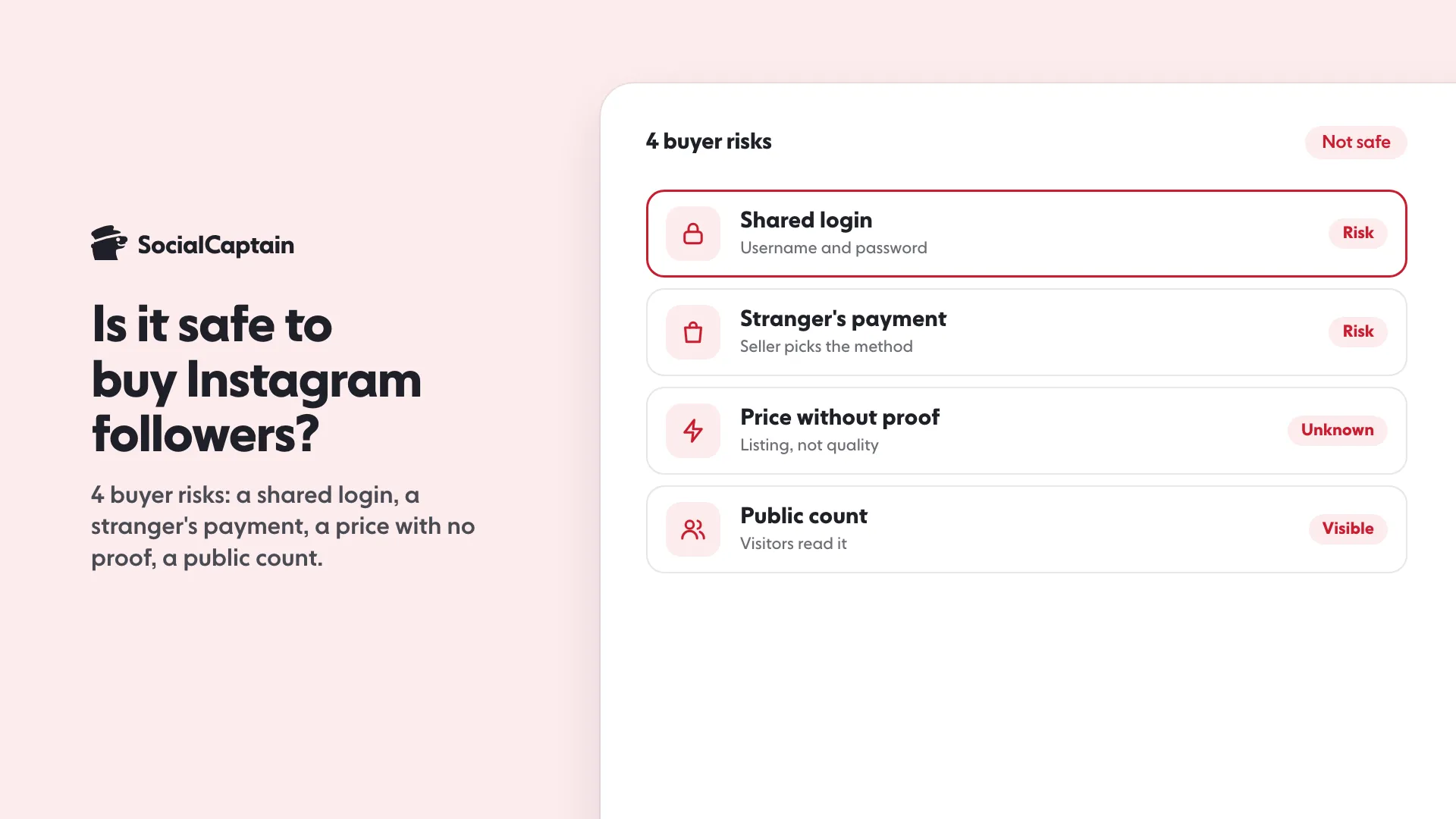
No, it is not safe for the buyer: you hand a stranger money, often a login, and get back a number that Instagram may remove and that other people can read. Four risks come with an order, and each has a source behind it: a shared login, a payment to a seller you cannot check, a price that says nothing about what you receive, and a follower count that stays on your profile for everyone to see. No source we read gives a rate of how many orders go wrong, so this guide does not either. It names the risks, shows what each source says and ends with the steps that lower them.
It leaves out what Instagram does to an account after an order, which is a different question. For that, read Can You Get Banned for Buying Instagram Followers? 4 Risks. It also does not repeat the business view, which Should a Business Buy Instagram Followers? 3 Rules, 4 Risks covers. This page is about the buyer: your login, your money and your profile.
Is it safe to buy Instagram followers?
Not on the evidence we could open. The table lists what you hand over in an order, what is at stake and where the source is.
| Risk | What you hand over | What is at stake | Source |
|---|---|---|---|
| 1. A shared login | Username and password | Someone else can sign in as you | Instagram, 19 November 2018 |
| 2. A stranger’s payment | Money, by a method the seller picks | A route to get it back, or none | FTC, July 2023 and May 2022 |
| 3. Price without proof | A number you cannot test | Cheap and costly listings look the same | UC3M and IMDEA study, published 2023 |
| 4. A visible count | Your profile’s public numbers | What visitors and sponsors read | Instagram 2018 post, FTC rule 16 CFR 465.8 |
The sections below take each risk in turn. The word “safe” here means safe for the buyer’s login, money and profile. It does not mean legal advice, and it does not say what Instagram will decide.
Risk 1: Is it safe to give a seller your Instagram login?
No. Instagram’s post “Reducing Inauthentic Activity on Instagram”, dated 19 November 2018, says “People who use these types of apps share their username and password.” The same post tells users who get its notice to “simply change your password to revoke their access to your account.”
Read what that means for a buyer. A login lets whoever holds it sign in as you. If you hand it to a seller, you cannot see what is done with it afterwards, and the post says changing the password is the way to cut that access off. Your own risk is not only the order. It is the access that stays behind after it.
SocialCaptain’s pricing page says it asks only for a public Instagram username, and a username is already visible to everyone. So the question to ask any seller is simple: what do you need from me? A username is a reasonable answer. A password or an access token is not, and it turns the order into the kind of app use Instagram’s post warns about. Instagram Bots: 5 Things They Do and the Risks of Each explains how those apps work.
If you reuse that password anywhere else, change it there too. That is ordinary account hygiene rather than something the post says.
Risk 2: Is it safe to pay a stranger for followers?
It is as safe as the way you pay, and the seller often picks the way. The FTC’s page “How To Avoid a Scam”, dated July 2023, is general advice on spotting scams and not about follower sellers, so it cannot tell you a given seller is one. What it does say is useful about payment: “Scammers tell you to PAY in a specific way.” It lists cryptocurrency, money-transfer companies, payment apps and gift cards as methods scammers ask for.
Use that as a test of the checkout and not of the seller. A seller that takes a credit card on a normal checkout page leaves you the issuer’s dispute process, which the FTC describes for credit cards. A seller that will only take gift cards, a wire or crypto leaves you no route that the FTC article describes, and it matches the pattern the FTC lists. The page also says scammers “PRESSURE you to act immediately”, so a countdown timer on an offer is a reason to wait, not to hurry.
One more FTC page matters after you pay. “How To Recognize and Avoid Phishing Scams” says legitimate companies “won’t email or text with a link to update your payment information.” If a seller emails you a link to re-enter your card for a “failed” order, treat it as a warning sign.
The price tells you nothing here, which leads to the next risk.
Risk 3: Can the price tell you what you will get?
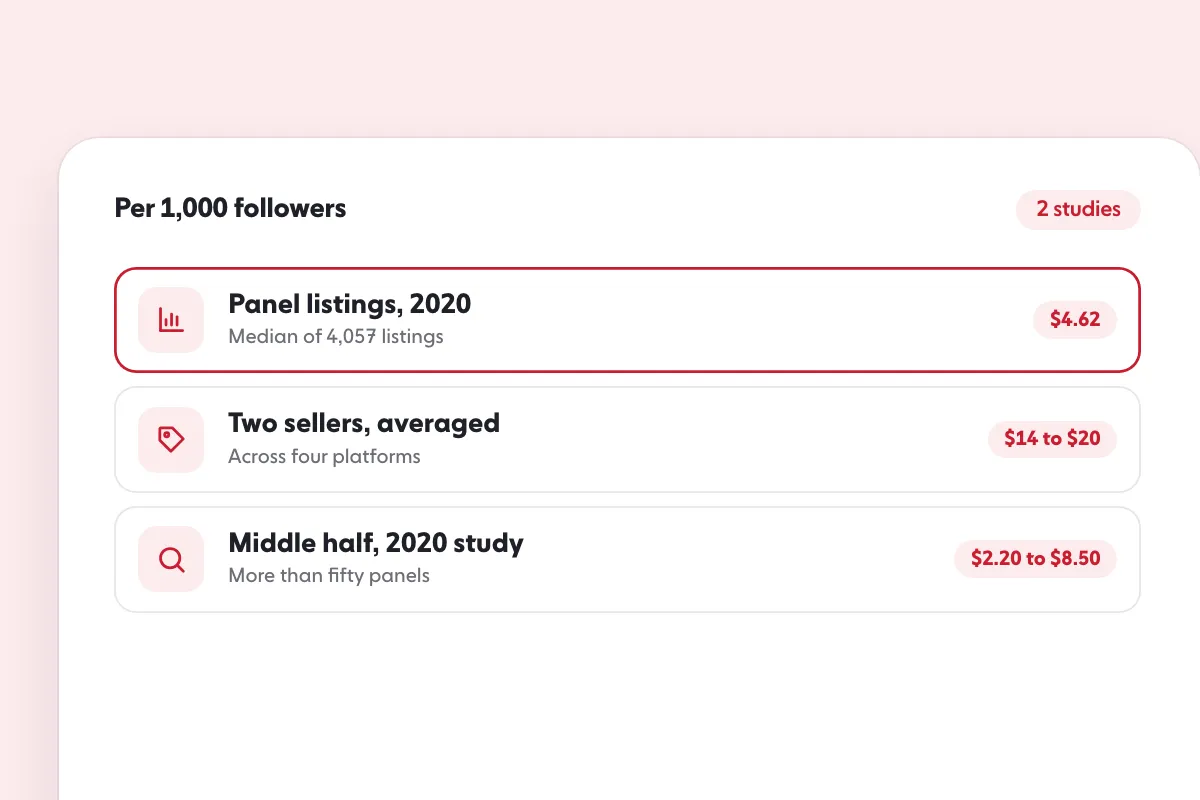
No. A peer-reviewed price study, by researchers from Universidad Carlos III de Madrid (UC3M) and IMDEA Networks, tracked more than fifty panels every day from March to August 2020. It found a median of $4.62 per 1,000 across 4,057 Instagram follower listings, with the middle half between $2.20 and $8.50 and the cheapest listing at $0.08.
The study measures listed prices, not what was delivered, how long followers stayed or whether the accounts were real. So a low listing is not shown to be a scam and a high one is not shown to be better. Panels also often resell other panels’ services at a higher price, so two listings for the same thing can differ for reasons the listing does not show. This is 2020 data, published in 2023: the latest measured market, not today’s quote, and we found no newer primary study of pack prices. The number you are paying for is the only part the listing tells you.
The same study, published in Computers & Security (volume 124, 2023), is described in a UC3M and IMDEA news item that quotes one author on the “disparity in prices between providers of the same service”, which he says suggests the market value of the service is unknown. It also found that many services can be customised by the origin and gender of the accounts that perform them, which is a reason to read “followers from your country” in an offer as a setting a seller chose, and not as proof that a real person is behind each one.
For the cost side in detail, Cost to Buy Instagram Followers goes through what moves the price.
Risk 4: Is it safe for your profile that others can see the count?
A follower count is public, and so is what is missing behind it. Anyone who opens your profile can compare the count with your likes and comments. A buyer who is asked for a media kit, or who sells to customers who check a profile before they trust it, carries the count into those meetings.
Instagram’s 2018 post says it would begin “removing inauthentic likes, follows and comments from accounts that use third-party apps”, which can change a count after the fact. The post covers accounts that use apps and not a buyer as such, and what Instagram does to an account is the subject of the ban guide linked above. The point for the buyer is narrower. What you paid for sits on a public page, and it can be read and judged by people who matter to you.
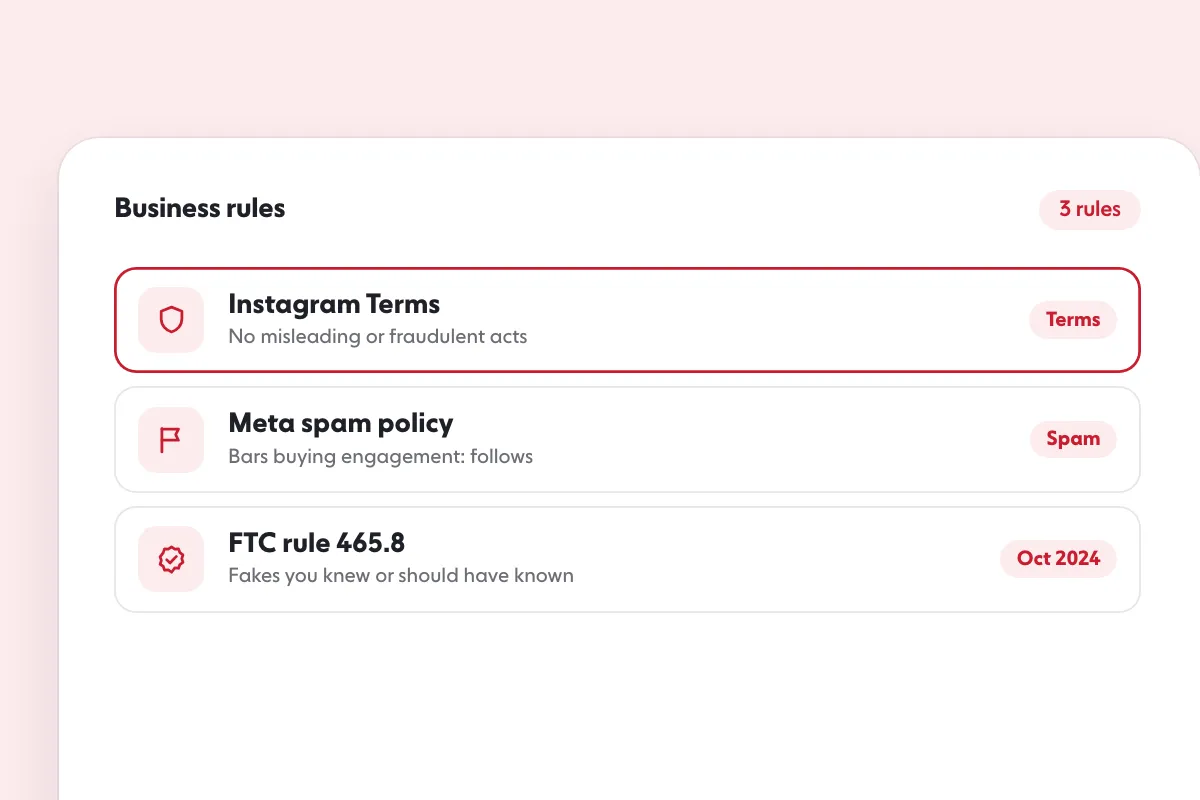
For a business there is a separate rule. The US FTC’s 16 CFR 465.8(b) covers buying fake indicators of social media influence “that they knew or should have known to be fake and that materially misrepresent their influence or importance for a commercial purpose”. The rule’s conditions are narrow, and this guide draws no legal conclusion for your case.
Can you get your money back?
Sometimes, and only if you paid in a way that has a route back. The FTC’s page “Using Credit Cards and Disputing Charges”, dated May 2022, describes the US Fair Credit Billing Act process for credit cards. It says covered problems include items that were not delivered as agreed, and that the dispute starts with a written letter to the card issuer.
The page counts the deadline from the first bill with the error, so read it before you wait. Two limits apply to anything you read here:
- It is a US process, for credit cards. The page does not describe it for other ways of paying.
- A seller’s own terms are separate. Some offer refills or refunds, and a refill is a promise from the same seller, not a protection.
This is a report of what the FTC page says and not legal advice. If a seller does not deliver, the first step in practice is to keep the order page, the confirmation email and the date of the charge.
What does a safer order look like?
A safer order reduces each risk above. Use this list before you pay anyone, including us.
- Ask what the seller needs from you. A public username only. A password, access token or “verify your account” link means stop.
- Check how the checkout takes payment. A credit card checkout leaves the dispute route the FTC describes (a US process). Gift cards, wire transfers and crypto are the payment methods the FTC says scammers ask for.
- Look for terms before you pay. A refund window and a plain description of what is delivered should be written down before the order, not promised afterwards.
- Ignore the timer. Pressure to buy now is one of the 4 signs the FTC lists for scams.
- Do not read the price as quality. The study above says listings show price, not delivered quality or retention.
- Keep records. Save the order page, the receipt and the date, because the dispute deadline starts at the bill.
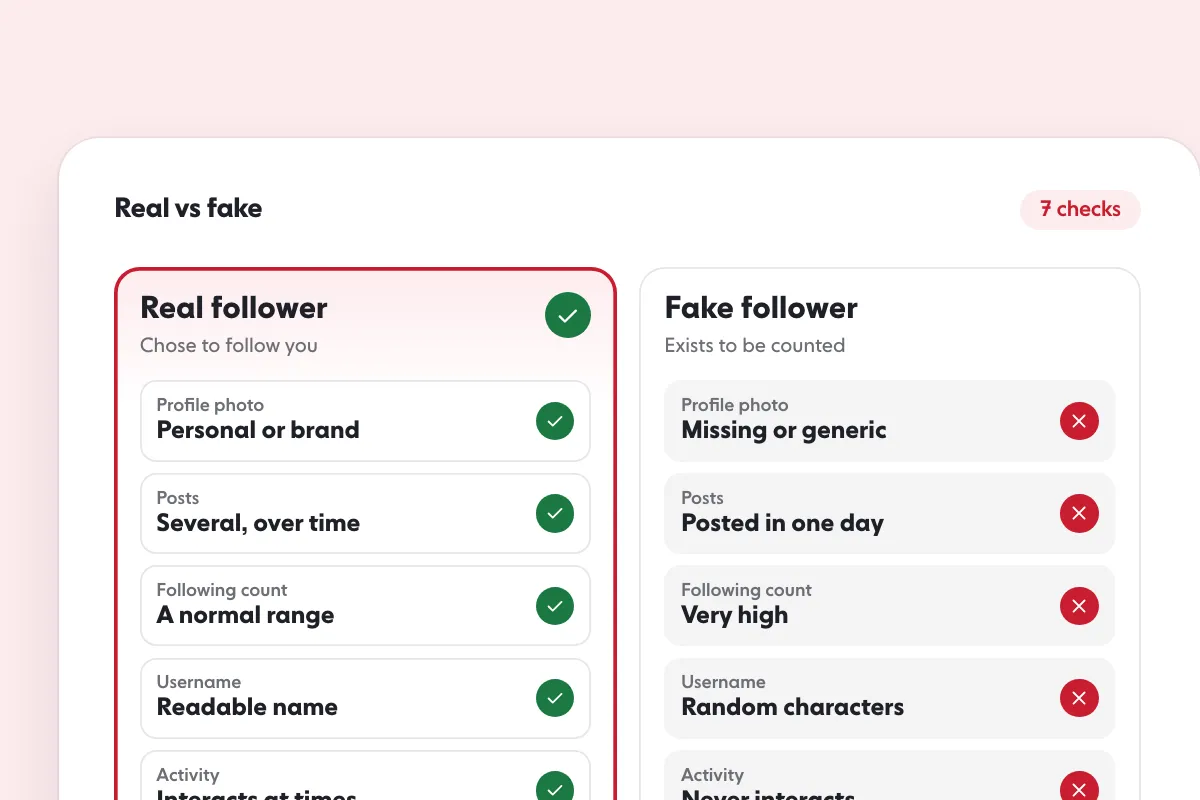
The longer checklist on what the followers themselves should look like is in Buy Instagram Followers: Real vs Fake and 7 Checks.
What should you do if you already handed over a login or paid?
Do these in order:
- Change the Instagram password at once if you gave it to anyone. The 2018 post says this revokes an app’s access.
- Stop any running order and do not buy a refill from the same seller.
- Check how you paid. If it was a US credit card and nothing was delivered as agreed, the FTC’s dispute deadline runs from the first bill with the charge.
- Keep the records. The order page, receipt and any messages are what you would send with a dispute.
- Do not pay anyone who offers to fix it. An offer to undo an order for another fee is one more payment to a stranger, which is risk 2 again.
Is a growth service safer for the buyer?
It can be safer on the buyer’s three counts: the login, the payment and the proof. A growth service that asks only for a username, as SocialCaptain’s pricing page says it does, removes risk 1. A credit card checkout with written terms and a money-back window addresses risk 2. And a service that says what it delivers, and to whom, gives you something to check against, which a bare price does not.
SocialCaptain works that way: real people matched to your niche, country and language, a public username and never a password, and a 14-day money-back guarantee on the first payment. As of 19 November 2026 the first-payment prices on the pricing page are $27.99 a month on Starter and $39.99 a month on Pro on the 6-month plan, and $47.99 and $68.99 month to month. The Instagram followers page explains how the matching works.
None of that makes any order immune to what Instagram decides. No source names a service as safe, and no vendor can promise it. To judge services on the same points, including ours, use best Instagram growth services.
If the offer is an app that asks for your login, Auto Followers for Instagram: What They Do and the 4 Risks covers what those apps do and their risks. For the other side of the choice, read Instagram Growth Service vs Buying Followers: 7 Differences.
FAQ
What do you risk as the buyer when you order Instagram followers?
Four things, each with a source: a login you may hand over, a payment to a stranger, a price that proves nothing about what you get, and a count that stays public on your profile. No source we read gives a rate of how many orders go wrong.
What should a follower seller need from you, and what is too much?
A public username is enough, and a username is already visible to everyone. A password, access token or “verify your account” link is too much: Instagram’s 2018 post says people who use follower apps share their username and password, and that changing the password revokes the app’s access.
Is it safe to pay for Instagram followers with a credit card?
A US credit card has a dispute route in the FTC’s guidance. The FTC says the Fair Credit Billing Act gives a dispute process for charges for items not delivered as agreed, started by a written letter to the card issuer. That is a US rule for credit cards.
Are cheap Instagram followers a scam?
Cheap is common, and the figures cannot say either way. A peer-reviewed study of 4,057 follower listings (2020 data, published 2023) found a median of $4.62 per 1,000, with the middle half between $2.20 and $8.50, and it measures listed prices, not delivered quality or retention.
Can you get your money back if the followers never arrive?
It depends on how you paid and on the seller’s own terms. For a US credit card, the FTC describes a written dispute to the issuer. A seller that takes only gift cards, wire transfers or crypto leaves no such route in the FTC article, and the FTC lists those as payment methods scammers ask for.
What does a safer follower order look like for the buyer?
It asks for a public username only, takes a credit card on a normal checkout, writes down its terms and any refund window before you pay, and gives no countdown pressure. It still cannot promise what Instagram does, and no source names any service as safe.
Sources
- Removing Fake Likes, Follows & Comments about.instagram.com
- FTC: How To Avoid a Scam (July 2023) consumer.ftc.gov
- FTC: Using Credit Cards and Disputing Charges (May 2022) consumer.ftc.gov
- FTC: How To Recognize and Avoid Phishing Scams consumer.ftc.gov
- An analysis of fake social media engagement services doi.org
- A study analyses fake interaction services on social media networks.imdea.org
- 16 CFR Part 465 law.cornell.edu
Related guides
Growth services
Buy Instagram Followers: Real vs Fake and 7 Checks
Growth services
Should a Business Buy Instagram Followers? 3 Rules, 4 Risks
Growth services
Cost to Buy Instagram Followers: $4.62 Median per 1,000
Written by Jonas Revel
Research editor
Jonas Revel runs research on the SocialCaptain blog: the statistics pages, account safety, and the fact-check every article gets before it goes live. Each number is traced to its original source and dated, and figures that cannot be traced are left out.
All articles by Jonas Revel


