Is It Illegal to Buy Instagram Followers? 1 US Rule, 5 Parts
Quick answer
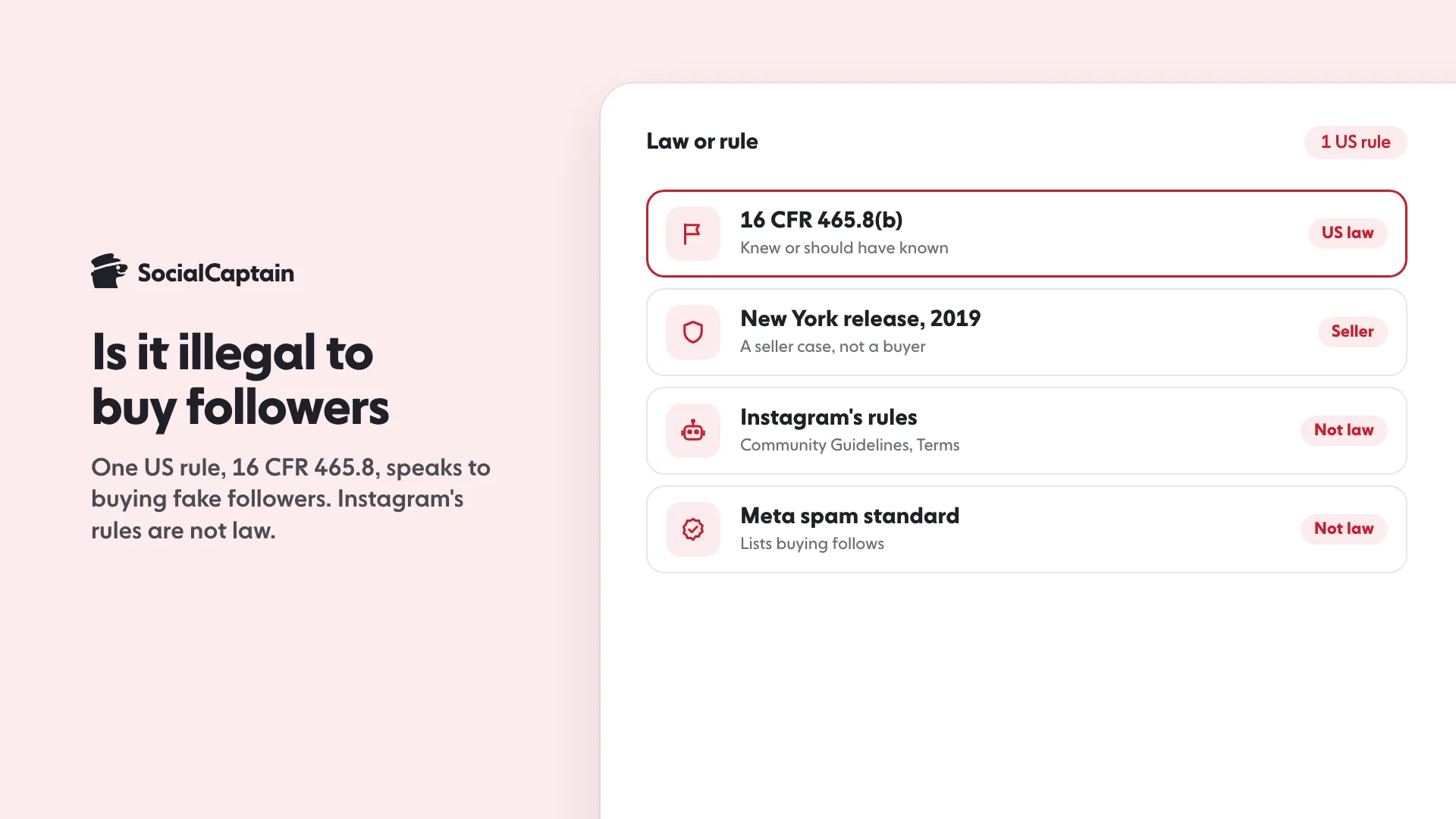
In the US, one federal rule speaks to it: 16 CFR 465.8(b) covers buying fake indicators of influence you knew or should have known were fake and that materially misrepresent your influence for a commercial purpose. Instagram's and Meta's rules are platform rules, not laws.
- 16 CFR 465.8(b) has 5 parts, from purchase to commercial purpose.
- Instagram's Terms and Meta's spam standard are platform rules, not laws.
- This page covers the US federal rule and one New York release only.
On this page12 sections
In the United States, one federal rule speaks directly to buying fake followers: 16 CFR 465.8(b), which makes it an unfair or deceptive practice to purchase fake indicators of social media influence that the buyer knew or should have known were fake and that materially misrepresent influence or importance for a commercial purpose. That sentence has 5 parts, and this page takes them one at a time. It also separates the rule from Instagram’s and Meta’s rules, which are platform rules and not laws. We report what the texts say, and the page covers no country other than the US.
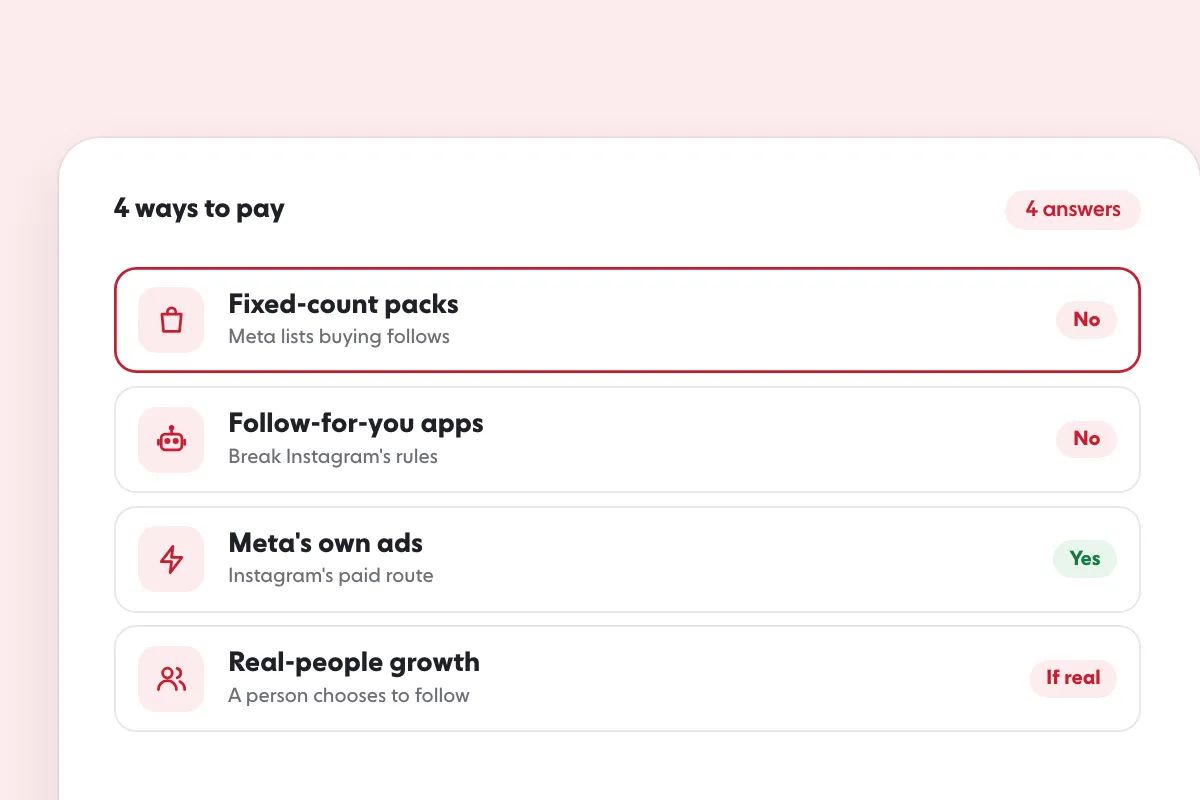
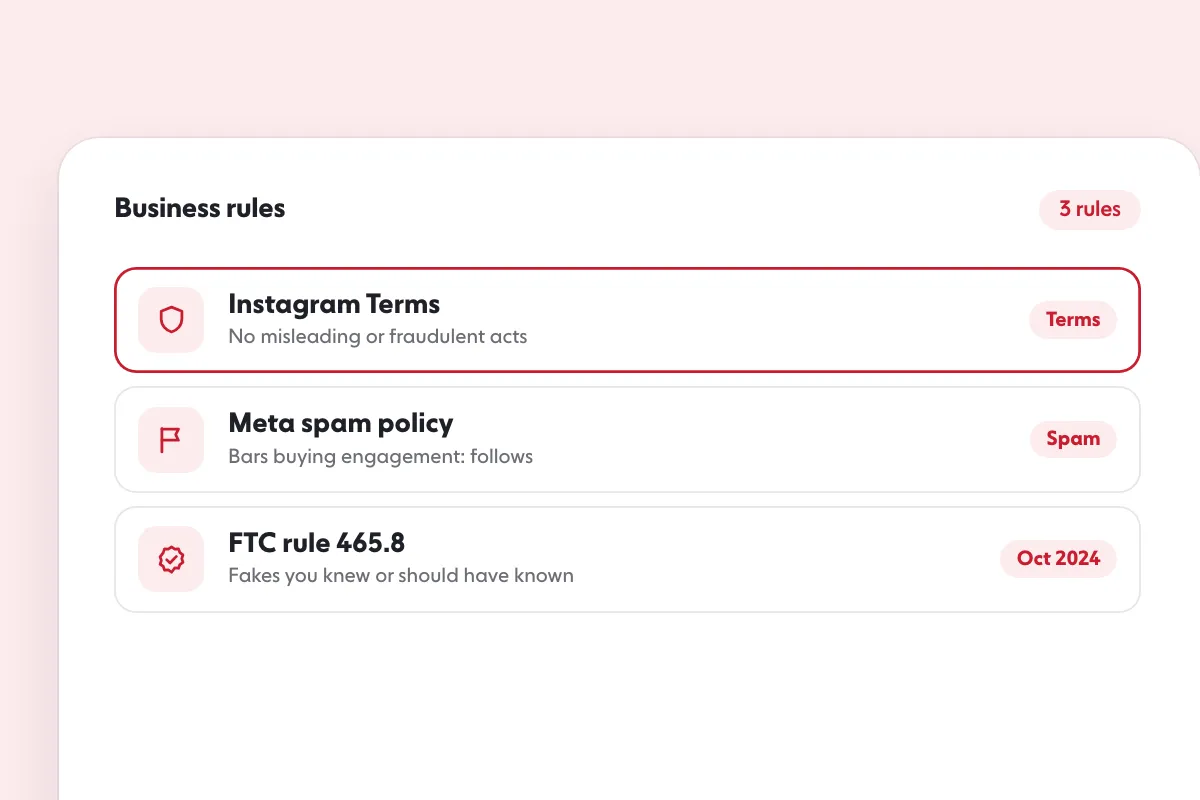
If you want to know what the platforms allow, read Can You Buy Instagram Followers? 4 Ways to Pay, 4 Answers. This page answers the narrower question of what the law text says. For the business side of the same rule, with the FTC’s own question-and-answer page, read Should a Business Buy Instagram Followers? 3 Rules, 4 Risks.
Is it illegal to buy Instagram followers?
The honest answer is “it depends on the facts, and only one source we opened is a law that speaks to it”. The table sorts every source we read by one question: is it law, or is it something else?
| Source | Is it law? | What it says about buying followers |
|---|---|---|
| 16 CFR 465.8 (federal rule; first eCFR version dated 21 October 2024) | Yes, a US federal rule | Buying fake indicators of social media influence that you knew or should have known were fake, and that materially misrepresent influence for a commercial purpose, is an unfair or deceptive practice |
| FTC press release, 14 August 2024 | No, an explanation of the rule | Says the rule prohibits “selling or buying fake indicators of social media influence, such as followers or views generated by a bot or hijacked account” |
| New York Attorney General release, 30 January 2019 | No, an enforcement announcement | A settlement with a seller of fake followers, likes and views on other platforms; its findings are about selling |
| Instagram’s post of 19 November 2018 | No, a platform statement | Apps that generate inauthentic likes, follows and comments violate Instagram’s Community Guidelines and Terms of Use |
| Meta’s spam standard | No, a platform standard | Lists “selling, buying, or exchanging for engagement, such as likes, shares, views, follows, clicks” |
Instagram’s post of 19 November 2018 (quoted below) says it removes inauthentic activity. A platform’s rules are its own: they are not made by a government, and breaking one is not breaking a law. A law can be enforced by a government, and it can apply whether or not Instagram ever notices. The two sets of rules can say the same thing about the same purchase, and they still work differently.
What does the US rule say about buying fake followers?
The rule is Part 465 of Title 16 of the Code of Federal Regulations, “Rule on the Use of Consumer Reviews and Testimonials”. Its authority line cites 15 U.S.C. 57a, and its source line cites Federal Register volume 89, page 68077, dated 22 August 2024. Most of the Part is about fake reviews. Section 465.8, “Misuse of fake indicators of social media influence”, is the part about followers.
It has two paragraphs. Paragraph (a) is the sell side. Paragraph (b) is the buy side. It reads: “Purchase or procure fake indicators of social media influence that they knew or should have known to be fake and that materially misrepresent their influence or importance for a commercial purpose.” The 5 parts inside that sentence are:
- Purchase or procure. The verb covers buying and arranging to get. The text does not limit it to a paid pack, and it does not say how the money moves.
- Fake indicators of social media influence. A defined term, covered in the next section.
- Knew or should have known. The buyer must have known the indicators were fake, or be in a position where they should have known. The Part does not define “should have known” and gives no list of signs.
- Materially misrepresent their influence or importance. The indicators must make the buyer look more influential or important than they are, in a way that matters.
- For a commercial purpose. The misrepresentation must serve a commercial purpose. The Part uses the phrase only in section 465.8 and does not define it.
Each part is a condition in the same sentence. We do not say which purchases meet all five. That depends on facts we do not have, and on how an agency or a court reads the words.
Which followers count as fake under the rule?
Section 465.1(h) defines fake indicators of social media influence as indicators “generated by bots, purported individual accounts not associated with a real individual, accounts created with a real individual’s personal information without their consent, or hijacked accounts, or that otherwise do not reflect a real individual’s or entity’s activities, opinions, findings, or experiences”.
Section 465.1(j) defines the indicators themselves: “any metrics used by the public to make assessments of an individual’s or entity’s social media influence, such as followers, friends, connections, subscribers, views, plays, likes, saves, shares, reposts, and comments”. So the rule is not only about followers. A bought like, view or comment is in the same list.
Two things about the definition are easy to over-read.
- The list ends with a catch-all. The words “or that otherwise do not reflect a real individual’s or entity’s activities” mean the four named kinds are not the only ones. We do not read the definition as clearing any category of follower, and we do not read it as covering every category.
- The text says nothing about how an account was found. It names bots, accounts not tied to a real person, accounts made with someone’s data without consent, and hijacked accounts. It does not discuss a real person who followed after seeing a profile in an ad or a recommendation. This page does not decide that question either way.
The FTC’s own release describes the same ground in plainer words. Its August 2024 release, as we read it on 19 November 2026, says the rule “prohibits anyone from selling or buying fake indicators of social media influence, such as followers or views generated by a bot or hijacked account”.
Does the rule apply to a personal account or only to a business?
Section 465.8 says “anyone”, not “a business”. The Part does define “business” in section 465.1(a), as an individual, partnership, corporation or other commercial entity that sells products or services, but paragraph (b) does not use that word.
What paragraph (b) does use is “for a commercial purpose”. That phrase is the link between the purchase and money. A follower count shown to sponsors, advertisers or customers is the kind of number the definition of indicators talks about. A count that nobody uses to make a commercial decision is a harder case, and the Part does not say how it is treated. We do not resolve it here.
What does the rule not say?
Reading the text for gaps is as useful as reading it for rules. Part 465 does not do these things:
- It names no platform. The text we read mentions no platform by name, so Instagram, TikTok and every other service fall under the same words.
- It has no penalty section. The Part ends at section 465.9, which is about severability, and none of the sections we read sets a penalty. The FTC’s release says the rule lets it “seek civil penalties against knowing violators”. That statement comes from the release, not from the Part’s text, and we have not read the penalty provisions that sit elsewhere in federal law.
- It gives no number. There is no follower count, no percentage and no amount of money at which a purchase starts or stops mattering.
- It lists no red flags. “Should have known” is left undefined in the text we read.
Has any government acted against sellers of fake followers?
The New York Attorney General did, in a settlement announced on 30 January 2019. The office said the settlement was “the first finding by a law enforcement agency that selling fake social media engagement and using stolen identities to engage in online activity is illegal”. It lists platforms where the seller’s fake activity was found, including Twitter, YouTube, LinkedIn, SoundCloud and Pinterest. The release does not mention Instagram.
Three limits of that release matter for your question.
- It is a settlement announcement, not a court ruling or a statute. It records the Attorney General’s findings and an agreement with the company.
- Its findings are about selling. It says the company’s practices deceived social media audiences, consumers, advertisers and other groups. It also says that some of the seller’s customers were deceived and many others knew they were buying fake activity. It does not say what happens to those customers.
- It is one US state’s office. It says nothing about the other 49 states.
Together with section 465.8(a), it is the clearest official signal we opened that selling fake engagement is something US authorities treat as deceptive. The two paragraphs share the conditions of knowing or should have known and of a commercial purpose. They differ in one phrase: paragraph (a) covers fake indicators that “can be used” to materially misrepresent influence, while paragraph (b) covers fake indicators that “materially misrepresent” the buyer’s own influence or importance.
What are Instagram’s and Meta’s rules, and are they law?
They are rules of a private company, and they apply to anyone who uses the service, in any country. They sit next to the law and do not replace it.
Instagram’s post “Reducing Inauthentic Activity on Instagram”, dated 19 November 2018 and read on 19 November 2026, says that “third-party apps that generate inauthentic likes, follows and comments violate our Community Guidelines and Terms of Use”. It says Instagram removes the inauthentic activity, sends an in-app message to accounts it identifies, and that accounts that keep using such apps “may see their Instagram experience impacted”. It adds that people who use these apps “share their username and password”, and that changing the password revokes an app’s access.
Meta’s spam standard, as we read it on 19 November 2026, lists among prohibited behaviors “selling, buying, or exchanging for engagement, such as likes, shares, views, follows, clicks”. The same standard says “We do not allow content that is designed to deceive, mislead, or overwhelm users in order to artificially increase viewership”.
For what these rules do to an account that breaks them, see What Happens When You Buy Instagram Followers: 5 Stages. The point for this page is the category: breaking a platform rule can cost you followers or an account, and it is a different matter from breaking a law.
Which countries does this page not cover?
Every country other than the United States, and every US state other than New York in the one release above. We opened no official text for the UK, the European Union or any of its member states, Canada, Australia, the UAE or anywhere else today. Consumer-protection and advertising law differs from place to place, and a rule that exists in one place says nothing about another.
Within the US, this page covers one federal rule and one state announcement. It does not cover state consumer-protection statutes, advertising codes, contract terms with sponsors or ad networks, or the terms of any brand deal. If you are about to sign a sponsorship that quotes your follower count, the terms of that contract may matter more than any of the sources here.
What does SocialCaptain offer instead of a pack of followers?
SocialCaptain is a growth service rather than a fixed pack. It asks for a public username and never a password, matches real people to your niche, country and language, and covers the first payment with a 14-day money-back promise. As read on 19 November 2026, first-payment prices on the pricing page are $27.99 a month on Starter and $39.99 a month on Pro on the 6-month plan, and $47.99 and $68.99 month to month.
That is what the service says about itself. This page does not say that any service, ours included, meets or fails 16 CFR 465.8, because that is a legal conclusion and not ours to give. To compare services on the same questions, use best Instagram growth services.
What can you check before you buy anything?
Five questions give you a record of what you were told, which is the part you control:
- Where do the followers come from? Ask the seller to say, in writing, how a person finds your profile.
- Is a fixed count promised by a deadline? That describes a pack, not a monthly plan with real people matched to your account.
- What do you have to share? Ask for the minimum: a public username, which is all SocialCaptain asks for. A password gives someone the ability to act as you.
- Is the seller named, with terms you can read? An offer with no terms leaves you with nothing to point to later.
- What would you show a sponsor or customer? If a count is part of your pitch, the number and the reality behind it should match. The rule’s phrase is “materially misrepresent”.
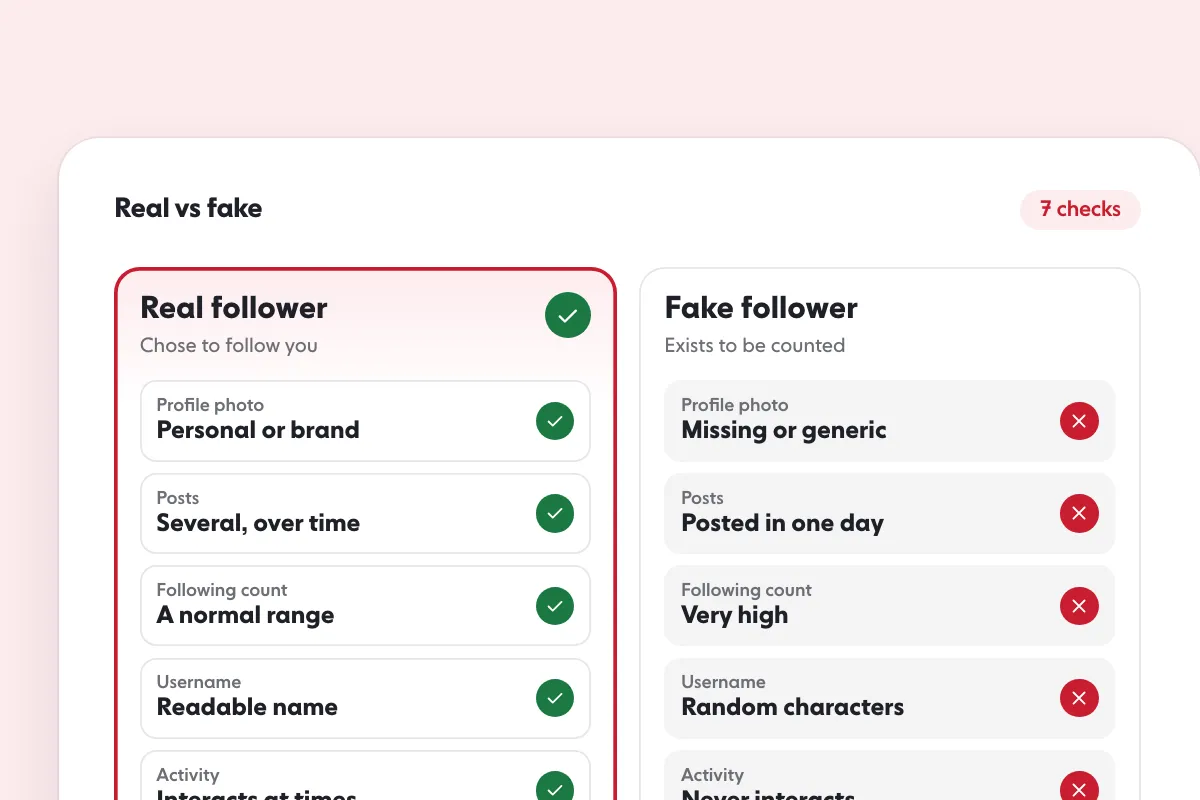
For the longer version of these checks, read Buy Instagram Followers: Real vs Fake and 7 Checks.
FAQ
Is it illegal to buy Instagram followers?
In the United States, one federal rule speaks to it. 16 CFR 465.8(b) makes it an unfair or deceptive practice to purchase fake indicators of social media influence that the buyer knew or should have known were fake and that materially misrepresent influence or importance for a commercial purpose. This page reports that text and does not apply it to your situation.
Is buying Instagram followers legal?
The sources we opened do not call every purchase legal or illegal. Part 465 targets fake indicators used to misrepresent influence for a commercial purpose. Instagram’s and Meta’s rules are separate: they are platform rules, not laws, and they name artificial growth as a violation.
Can you go to jail for buying Instagram followers?
The text of 16 CFR Part 465 that we read sets no criminal penalty and has no penalty section. The FTC’s August 2024 release says the rule lets it seek civil penalties against knowing violators. Penalties set outside the Part were not read for this page, and whether any other law applies depends on where you live.
Does it matter if you did not know the followers were fake?
For the buyer side of the rule, yes. Section 465.8(b) applies to indicators the buyer knew or should have known to be fake. The rule text does not define what a buyer should have known, and we do not read it for you.
Does the rule apply to a personal account?
Section 465.8 says it applies to anyone, and it ties the buyer side to misrepresenting influence or importance for a commercial purpose. The Part does not define commercial purpose, so this page does not say where a personal account falls.
Is it illegal to sell Instagram followers?
Section 465.8(a) covers selling or distributing fake indicators that the seller knew or should have known were fake and that can be used to misrepresent influence for a commercial purpose. In 2019 the New York Attorney General announced a settlement with a seller of fake followers and likes on other platforms.
Sources
- 16 CFR Part 465 law.cornell.edu
- FTC final rule banning fake reviews and testimonials (press release) ftc.gov
- Attorney General James announces settlement with sellers of fake followers and likes (30 January 2019) ag.ny.gov
- Removing Fake Likes, Follows & Comments about.instagram.com
- Spam transparency.meta.com
Related guides
Growth services
Buy Instagram Followers: Real vs Fake and 7 Checks
Growth services
Can You Buy Instagram Followers? 4 Ways to Pay, 4 Answers
Growth services
Should a Business Buy Instagram Followers? 3 Rules, 4 Risks
Written by Jonas Revel
Research editor
Jonas Revel runs research on the SocialCaptain blog: the statistics pages, account safety, and the fact-check every article gets before it goes live. Each number is traced to its original source and dated, and figures that cannot be traced are left out.
All articles by Jonas Revel


