Instagram Follower Tiers in the US: 89.2% Nano, 9.4% Micro
Quick answer
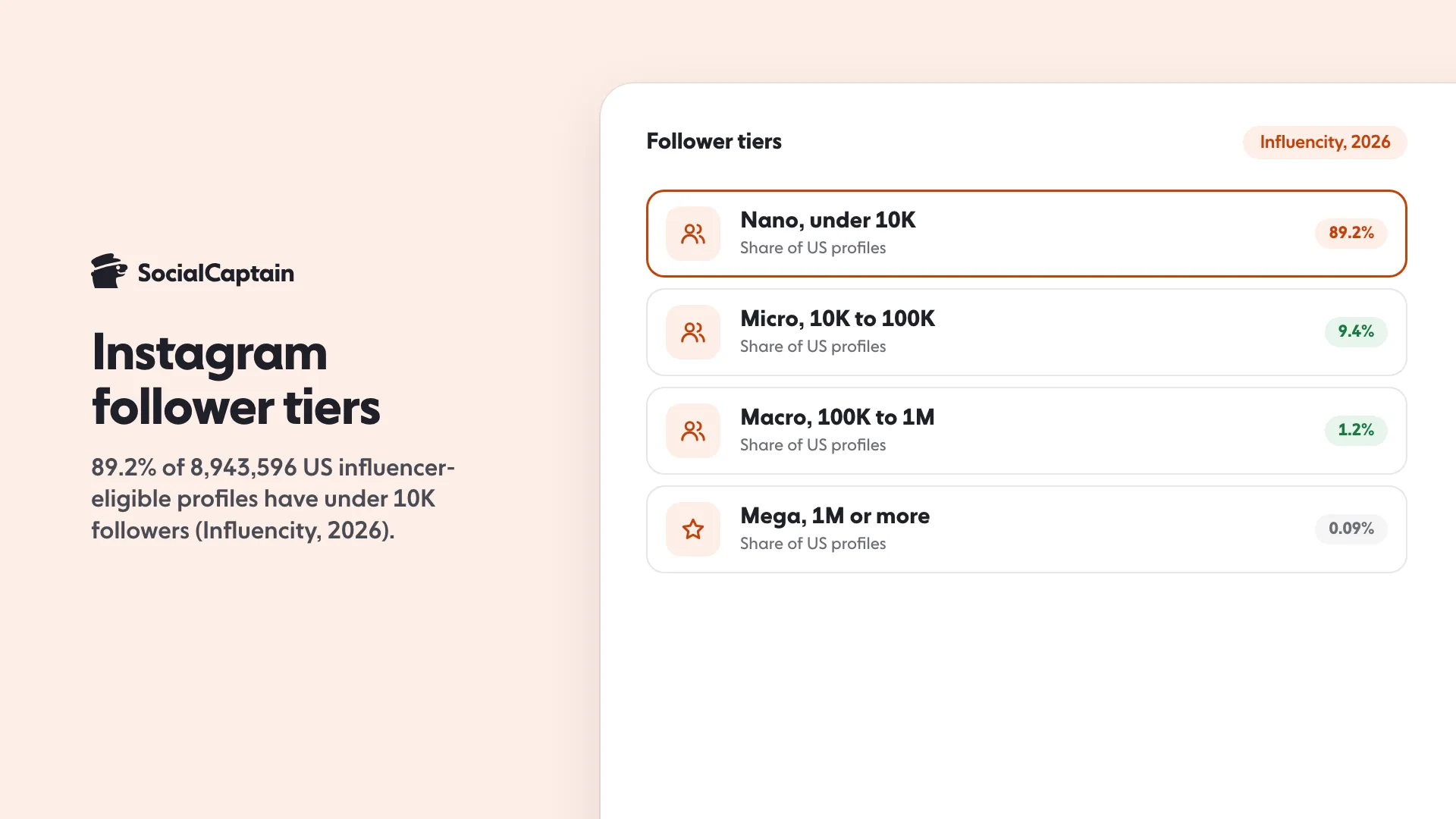
89.2% of 8,943,596 US influencer-eligible Instagram profiles have under 10K followers (nano); 9.4% have 10K to 100K, 1.2% 100K to 1M and 0.09% 1M or more (Influencity, 2026). None of the sources publishes an average follower count.
On this page 10 sections
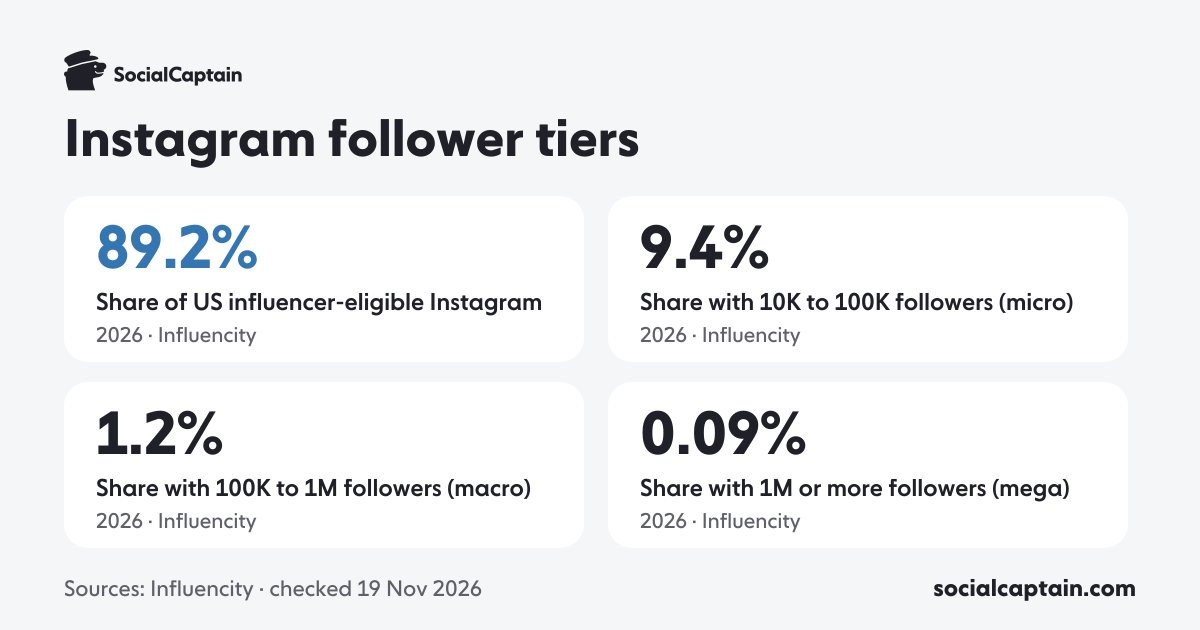
Instagram follower tiers are very uneven: 89.2% of US influencer-eligible Instagram profiles are nano (under 10K followers), 9.4% are micro (10K to 100K), 1.2% are macro (100K to 1M) and 0.09% are mega (1M or more). Those shares come from Influencity’s 2026 study of 8,943,596 profiles, which we read on its publisher’s own page on 19 November 2026. None of the three sources on this page publishes an average follower count, so this page answers with tier shares and prints no average.
89.2%
Share of US influencer-eligible Instagram profiles with under 10K followers (nano)
9.4%
Share with 10K to 100K followers (micro)
1.2%
Share with 100K to 1M followers (macro)
0.09%
Share with 1M or more followers (mega)
What share of Instagram accounts are nano, micro, macro and mega?
For US influencer-eligible profiles, 89.2% are nano, 9.4% micro, 1.2% macro and 0.09% mega. This is the tier table from section 08 of Influencity’s 2026 study of Instagram influencer marketing in the United States. The study counts profiles that Influencity’s database treats as influencer-eligible, so it is not a count of every Instagram account.
| Tier | Followers | Profiles | Share of eligible profiles |
|---|---|---|---|
| Nano | Under 10K | 7,982,115 | 89.2% |
| Micro | 10K to 100K | 842,407 | 9.4% |
| Macro | 100K to 1M | 110,780 | 1.2% |
| Mega | 1M or more | 8,294 | 0.09% |
| Total | All tiers | 8,943,596 | 100.0% |
Influencity derives the nano row as all eligible profiles minus the three larger tiers, so it includes about 0.2% of profiles not assigned to any tier. The four rounded shares printed above add up to 99.89% (our arithmetic). For what each tier is and what its accounts charge, see nano influencers and micro influencers.
How many Instagram accounts have 10K followers or more?
In this study, 961,481 profiles, or 10.8%, have 10,000 followers or more; the other 89.2% have fewer. That is about one profile in nine (100 divided by 10.8, our arithmetic). The 961,481 equals the micro, macro and mega counts added together (our check).
Influencity also gives the tiers per 100,000 estimated US Instagram users: for every 100,000 of them there are about 437 micro, 58 macro and 4 mega profiles. Its sample of 8,943,596 profiles sits against an estimated 192,606,008 US Instagram users, across 50 states, and the unit is a profile, not a person. The 8,943,596 is about 4.6% of the 192,606,008 (our arithmetic), so the rest of the estimated users are not in the table.
Do the tier shares differ by region?
Only slightly. Influencity’s regional comparison puts nano at 87.4% in Europe and 88.3% in Latin America, against 89.2% in the US, and mega between 0.066% and 0.093%.
| Tier | US | Europe | Latin America |
|---|---|---|---|
| Nano (under 10K) | 89.2% | 87.4% | 88.3% |
| Micro (10K to 100K) | 9.4% | 11.3% | 10.5% |
| Macro (100K to 1M) | 1.24% | 1.24% | 1.09% |
| Mega (1M or more) | 0.093% | 0.066% | 0.068% |
Influencity says Europe and Latin America use reported tier entries, so the differences are indicative. The same page gives the US nano share as 89.5% on a tier-entry basis, and shows the US macro share as 1.2% in the main table and 1.24% here; we print each as published.
What does HypeAuditor’s report say about creators?
HypeAuditor’s report shows a different nano share for the influencer accounts in its own database, and it prints two different splits on the same page. The figures below are from HypeAuditor’s State of Influencer Marketing 2026 report (a 34-page PDF, page 15), read from the report’s own file on 19 November 2026. HypeAuditor says the report analysed 88.7 million Instagram influencer accounts from its internal database.
| HypeAuditor tier | Followers | Share in the page text | Share in the page chart |
|---|---|---|---|
| Nano | 1K to 10K | 81.5% | 75.9% |
| Micro | 10K to 50K | 14.4% | 13.6% |
| Mid-tier | 50K to 500K | 3.8% | 3.4% |
| Macro | 500K to 1M | 0.3% together with mega | 0.2% |
| Mega | Over 1M | 0.3% together with macro | 0.1% |
The text and the chart disagree: the text shares add up to 100.0%, the chart bars to 93.2% (our arithmetic), and the page’s own headline says more than 80% are nano. HypeAuditor does not say which is right, so we print both and quote neither as a single figure. The report does not state the period of the split, and its tiers differ from Influencity’s: its smallest tier starts at 1K, its micro tier stops at 50K, and it has a mid-tier. The nano shares are therefore not comparable with Influencity’s 89.2%.
Do smaller Instagram accounts grow faster?
Yes, in percentage terms; Socialinsider is the only one of the three sources that measures growth by tier. Socialinsider’s 2026 Instagram benchmark of brand accounts shows a follower growth rate in 2025 that falls steadily as accounts get larger, and every tier grew more slowly than in 2024.
| Brand size | Follower growth 2024 | Follower growth 2025 |
|---|---|---|
| 1K to 5K followers | 38.00% | 22.00% |
| 5K to 10K followers | 35.00% | 20.29% |
| 10K to 50K followers | 33.80% | 17.20% |
| 50K to 100K followers | 30.00% | 13.62% |
| 100K to 1M followers | 27.00% | 11.25% |
The study covers 67,541,436 organic posts from business accounts. Its page says the figures labelled 2026 are 2025 values. The page is inconsistent in places: it says it covers brands with 1K to 1M followers, but also says accounts with fewer than 1,000 or more than 100,000 followers were left out, which its own 100K-to-1M row contradicts. Its period line reads January 2024 to December 2026. These are brand accounts, so a personal account may grow differently.
Why do the tier shares differ between sources?
Because each source counts a different group with different tier edges.
- Who is counted: Influencity counts US influencer-eligible profiles; HypeAuditor counts the influencer accounts in its own database; Socialinsider counts business accounts of brands.
- Tier edges: Influencity’s nano is every profile under 10K, HypeAuditor’s starts at 1K, and Socialinsider’s lowest tier is 1K to 5K. Influencity’s micro runs to 100K, HypeAuditor’s to 50K.
- How the data was gathered: Influencity’s is a non-random database extract with no margin of error; HypeAuditor’s shares are machine-learning estimates; Socialinsider’s are averages within each tier.
- Unit: each source counts accounts or profiles, not people, so one person with two accounts can appear twice.
What is not published?
- No average or median per tier. None of the three sources prints the average or median followers of a tier, so this page prints none.
- No share for all Instagram accounts. Each source covers a selected group, so the share of every account with 10K followers is not known.
- No visible date on Influencity’s study. The page shows no publication or update date in its text; its page data lists publication on 14 October 2026 and an update on 13 November 2026, and its references give the database export as October 2026.
- No period for HypeAuditor’s split. The report does not say when its tier split was measured.
- Two HypeAuditor splits. The text and the chart on page 15 disagree, and the report gives no reason.
What these numbers mean for your account
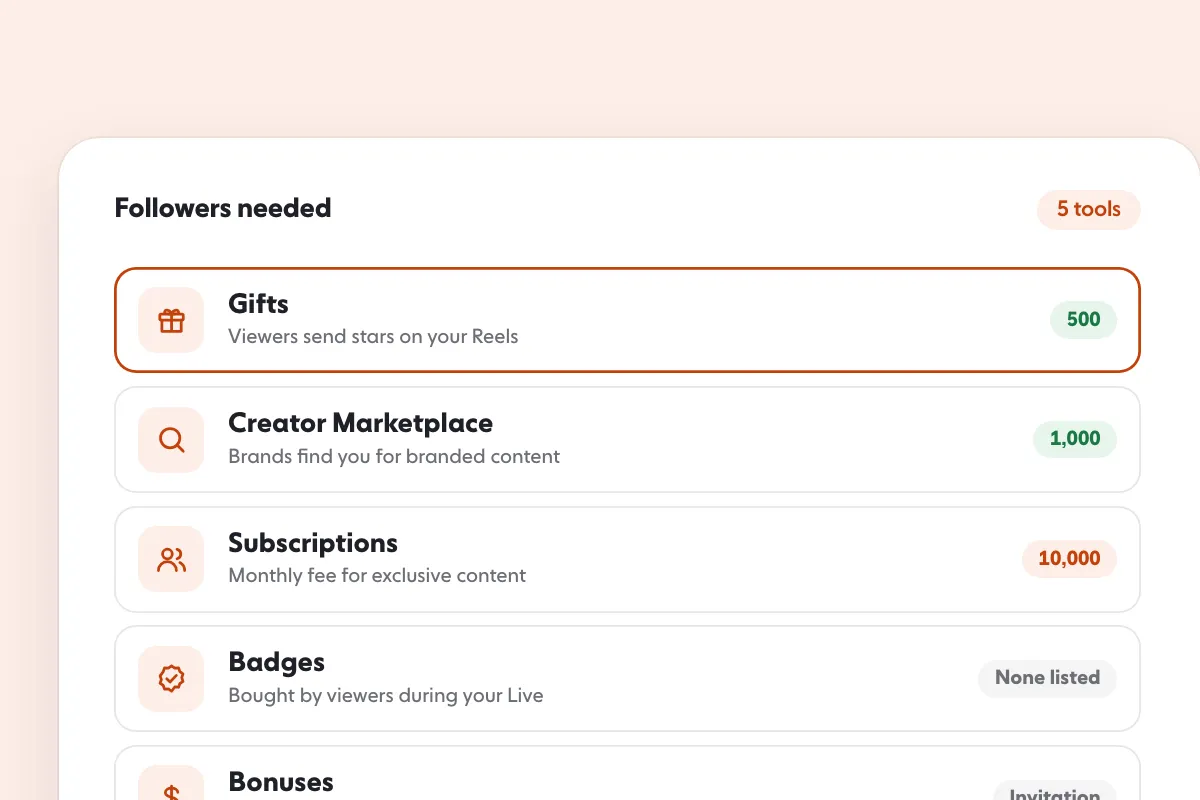
Crossing 10K followers puts an account in the top 10.8% of US influencer-eligible profiles in Influencity’s data, and 100K in the top 1.3% (our sum of the macro and mega shares). Treat the tiers as a map of where you stand within one database, not as a target: Instagram sets no official tiers, and the edges vary by source. Instagram’s own follower minimums for tools and income are covered in how many followers you need to be an Instagram influencer and Instagram monetization.
For median follower counts reported by studies of sponsored accounts, see average number of followers on Instagram; this page covers tier shares only. To add real, niche-matched followers from people in your audience, see Instagram followers, the Instagram growth service and the plans. More benchmarks are on the Instagram statistics page.
How we got these numbers
| Study | Sample | Period | Counts |
|---|---|---|---|
| Influencity Instagram Influencer Marketing in the United States 2026 Study, 14 Oct 2026 | 8,943,596 influencer-eligible US Instagram profiles of an estimated 192,606,008 US Instagram users, 50 states; non-random database extract, no margin of error; unit is a profile | Database export October 2026 (per the page's references); no visible date in the page text, page data lists published 2026-10-14 and modified 2026-11-13 | Share of eligible profiles by follower tier (nano under 10K, micro 10K-100K, macro 100K-1M, mega 1M+); regional comparison |
| Socialinsider 2026 Instagram Benchmarks, 20 Feb 2026 | 67,541,436 organic brand posts from business accounts with 1K to 1M followers (page also says accounts under 1,000 or over 100,000 were left out) | Page says the figures labelled 2026 are 2025 values; period line reads January 2024 to December 2026; page modified 2026-11-04 | Follower growth rate by brand size, 2024 and 2025 |
| HypeAuditor The State of Influencer Marketing 2026: Benchmarks and Trends, 2026 | 88.7 million Instagram influencer accounts from HypeAuditor's internal database (report methodology, page 34); machine-learning estimates | Not stated for the tier split; the report prints no date, only 2026 on its cover | Distribution of Instagram influencers by number of followers (page 15), text and chart |
Each study read on its publisher's own page on 19 November 2026. We re-check every figure at least every 120 days.
- Influencity's tier table covers 8,943,596 influencer-eligible US Instagram profiles from a non-random database extract (export October 2026, no margin of error); the unit is a profile, not a person.
- HypeAuditor's page 15 prints two different splits, in its text and in its chart; both are shown as published (report file read 2026-11-19).
- Socialinsider's page labels 2025 values as 2026 and contradicts itself on which account sizes were included; its table is printed as published.
- Every printed figure is the source's own; counts, sums and ratios on the page are marked as ours.
Data as CSV Data as JSON Infographic
Cite this page
SocialCaptain (2026). Instagram follower tiers 2026. Data checked 19 November 2026. https://socialcaptain.com/blog/instagram-follower-tiers/
FAQ
How many Instagram accounts have 10K followers?
In Influencity’s 2026 study of 8,943,596 US influencer-eligible profiles, 961,481 profiles (10.8%) have 10,000 followers or more, so 89.2% have fewer. That is a count of profiles in one database extract, not of all Instagram accounts, and Influencity states no margin of error.
What percentage of Instagram accounts are nano, micro, macro and mega?
For US influencer-eligible profiles in Influencity’s 2026 study: nano (under 10K) 89.2%, micro (10K to 100K) 9.4%, macro (100K to 1M) 1.2% and mega (1M or more) 0.09%. HypeAuditor’s 2026 report gives a different split for the influencer accounts in its own database, with 81.5% in its 1K-to-10K tier in its text and 75.9% in its chart.
Does any source give an average size for each follower tier?
None of the three sources we read publishes an average or a median follower count for each tier, so we print none. They publish tier shares instead. For the studies of sponsored accounts that do report medians, see the separate post on the average number of followers on Instagram.
Do smaller Instagram accounts grow faster?
In Socialinsider’s 2026 benchmark of brand accounts, yes: the follower growth rate in 2025 was 22.00% for brands with 1K to 5K followers and 11.25% for brands with 100K to 1M. Every tier grew more slowly than in 2024, when the range was 38.00% down to 27.00%.
Why do studies disagree on the share of nano influencers?
They count different things. Influencity counts every US influencer-eligible profile under 10K as nano (89.2%), while HypeAuditor’s nano tier starts at 1K and covers 81.5% of Instagram influencers in its text. HypeAuditor’s own chart shows 75.9% on the same page.
Related guides
Written by Lena Ashby
Creator business and analytics editor
Lena Ashby covers the business side of Instagram on the SocialCaptain blog: Insights and engagement rates, when to post, content plans and how creators earn. Each article says where its figures come from and lists its sources at the end.
All articles by Lena Ashby


