Average Number of Followers on Instagram: 2 Studies, 4 Tiers
Quick answer
Instagram publishes no average follower count. Research on accounts posting sponsored content gives a median of 23.7K followers (about 12,000 accounts, 2020) and about 51K for personal accounts (about 766,000 accounts, 2026).
23.7Kmedian followers in a 2020 study of about 12,000 sponsored-content accounts
- No official average: only samples of creator accounts exist.
- Medians: 23.7K (2020 study) and about 51K (2026 study).
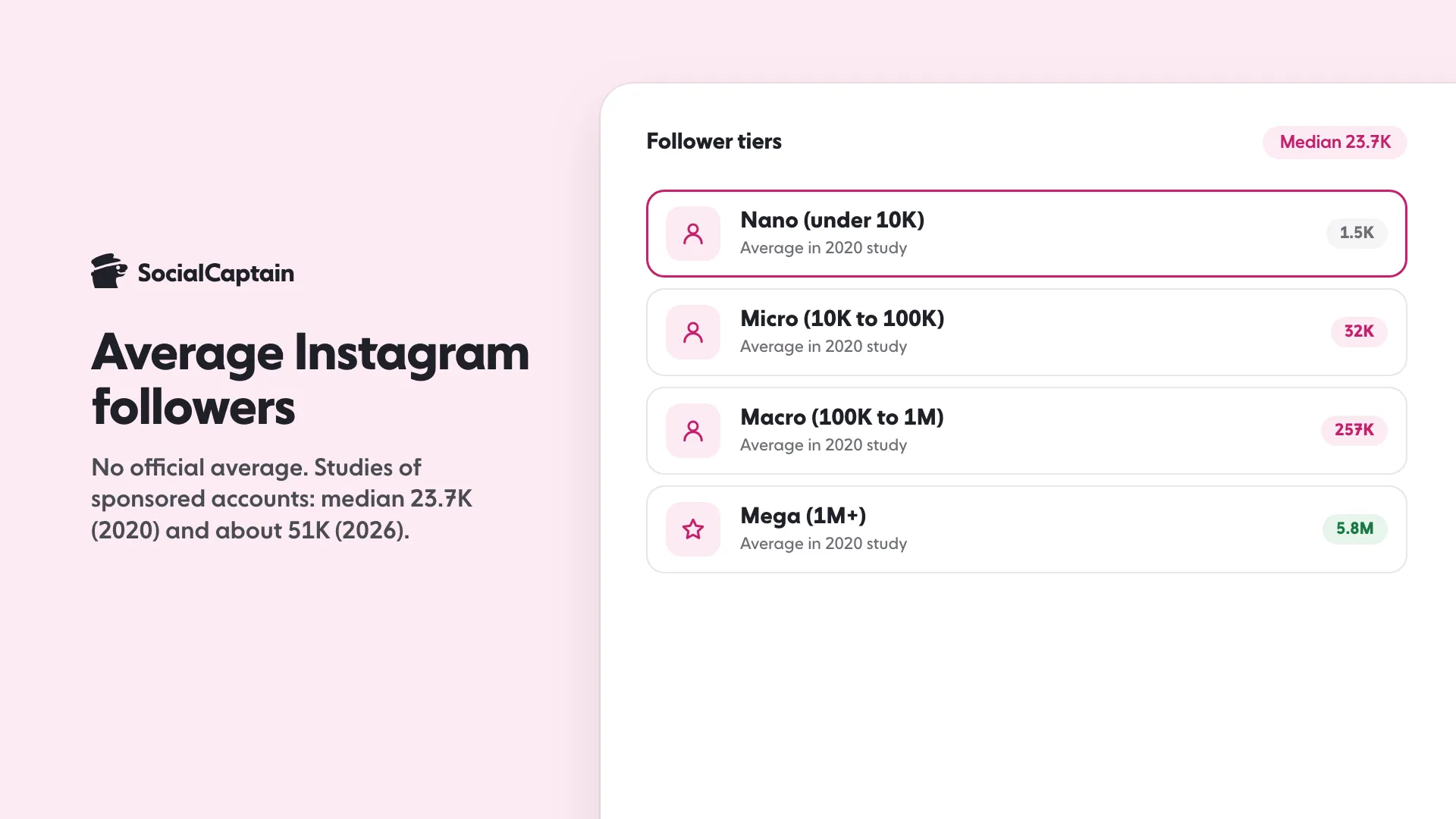
- Tier averages (2020): nano 1.5K, micro 32K, macro 257K, mega 5.8M.
On this page11 sections
Instagram does not publish an average number of followers, and the research that exists measures creators, not everyone. Two studies of accounts that post sponsored content put the median at 23.7K followers (a 2020 sample of about 12,000 accounts) and about 51K for personal accounts (a 2026 sample of roughly 400,000). In the older study, 37% of accounts had under 10K followers and 17% had over 1 million, and the four size tiers averaged 1.5K, 32K, 257K and 5.8 million. This page sets out those numbers, what each sample can and cannot tell you, and how to measure your own account against the people who matter to it. We opened every source on its publisher’s own page on 18 November 2026.
What is the average number of followers on Instagram?
There is no official answer. Instagram has said how many people use it (3 billion a month, below) and publishes a free insights tool for your own account, but we found no page from Instagram or Meta that gives a mean or median follower count for all accounts. So any single “average” you see quoted without a method is not from Instagram.
What we can offer is every figure that comes from a primary source we could open, with its sample stated next to it:
| Figure | Value | Who it describes | Source |
|---|---|---|---|
| Median followers | 23.7K | About 12,000 accounts that posted with sponsorship hashtags (2018 to 2019 crawl) | Zarei et al., arXiv, 2020 |
| Median followers | about 51K | Personal accounts in a sample of about 766,000 accounts that posted sponsored content | Lima and Goussevskaia, arXiv, 2026 |
| Accounts under 10K followers | 37% | The same 12,000-account sample | Zarei et al. |
| Accounts over 1M followers | 17% | The same 12,000-account sample | Zarei et al. |
| Adults who use Instagram | 51% (US) | A survey of 5,511 US adults, 30 January to 18 June 2026 | Pew Research Center |
| Monthly active users | 3 billion | Everyone who uses the app, worldwide | Meta Newsroom, 28 September 2025 |
The first two rows are the closest thing to an answer, and both come from samples that were chosen because the accounts post sponsored content. A median of 23.7K therefore tells you about people who work with brands, not about the friend you know with 400 followers. Both studies are explained below.
Why does Instagram have no single average follower count?
Follower counts are not spread evenly, so a single average hides more than it shows. In the 2020 study the biggest accounts averaged 5.8 million followers while the smallest tier averaged 1.5K. A handful of accounts at the top pull a mean far above what a typical account has, which is why researchers quote a median (the middle account when you line them all up) instead.
Three more reasons no clean number exists:
- Instagram counts people, not profiles. The 3 billion figure is monthly active users. A person can hold several accounts, and a profile can sit unused, so users and accounts are different things. Meta’s figure does not say how many accounts exist.
- Who is in the sample decides the answer. Studies that find accounts through sponsorship hashtags find creators. A study that sampled every account would need access to Instagram’s own data, and we found none published.
- Counts move. Instagram removes disabled accounts and inauthentic activity routinely (more on that below), so a snapshot taken last year would not match one taken today.
What does the research on follower counts show?
Two research papers on arXiv, the open archive for preprints, give the most useful numbers. They are preprints, so they have not necessarily been through journal peer review. Both are about accounts that promote products, so read them as “how big are creator accounts”, not “how big is the typical account”.
The 2020 study: 12,000 accounts, median 23.7K
Koosha Zarei and six co-authors (from Institut Polytechnique de Paris, Queen Mary University of London and MIT) published “Characterising and Detecting Sponsored Influencer Posts on Instagram” on 11 November 2020. They found accounts by crawling posts that used sponsorship hashtags such as #ad, #advert and #sponsored between September 2018 and April 2019. That identified about 12,000 accounts, which they then followed from July to August 2019.
Their findings on follower counts:
- The median follower count was 23.7K, against a median of only 770 accounts followed.
- 35% of the accounts had over 100K followers and 17% had over 1 million.
- 37% had fewer than 10K followers, and 15.5% had fewer than 1K.
- By subtraction, that leaves about 28% of accounts between 10K and 100K and about 18% between 100K and 1M. These two shares are our arithmetic, not a figure the paper prints.
The authors point out that the long tail at the bottom surprised them. They checked by hand and confirmed that accounts with a few hundred followers were doing real sponsored posts. In their words, influencers “are not just celebrities”. That matches what many small creators see: promotion is not reserved for large accounts.
The study is also old. The data was collected in 2018 and 2019, and Instagram has changed a great deal since, so use it for the shape of the spread rather than as today’s level.
The 2026 study: 766,000 accounts, median about 51K for people
Pedro Victor de Sousa Lima and Olga Goussevskaia published “Predicting Engagement with Sponsored Content Across Account Types on Instagram” on arXiv on 5 October 2026. Their data came from CrowdTangle, Meta’s research tool that shut down in 2024. It covers about 15.7 million posts from about 766,000 accounts, collected through sponsorship-disclosure hashtags and through the accounts that got the most interaction or mentions in that set.
They sorted accounts by type (a person, a company, a place, a product and so on). For accounts classed as a person, they report:
- A median of about 51K followers, the highest of any account type. The paper gives no median for the other types in its text.
- 302,392 person accounts with at least 1,000 followers, of which 203,447 were micro (1,000 to under 100,000 followers), 86,611 macro (100,000 to under 1 million) and 12,334 mega (1 million or more).
- A further 99,687 person accounts below 1,000 followers, which the authors left out of their tier analysis.
Put together, the tier shares among the 302,392 are 67% micro, 29% macro and 4% mega. If the 99,687 under-1,000 accounts are added back, about one in four person accounts in the sample (24.8%, our arithmetic) had under 1,000 followers. The paper itself says the way it collected posts is a lower bound for sponsored content, and the sample favours accounts with a lot of interaction, so the median is higher than it would be for a group that was not selected on visibility.
The two studies differ by a factor of two on the median (23.7K against about 51K). The simplest explanation is that they used different samples, different years and different filters. We would not average them.
How many followers do nano, micro, macro and mega accounts have?
Instagram does not define these tiers on any page we could find, so the names come from researchers and the marketing industry. The two studies above use these lines:
| Tier | 2020 study: follower range | 2020 study: average followers | 2026 study: follower range |
|---|---|---|---|
| Nano | under 10K | 1.5K | not used |
| Micro | 10K to under 100K | 32K | 1,000 to under 100K |
| Macro | 100K to under 1M | 257K | 100K to under 1M |
| Mega | 1M or more | 5.8M | 1M or more |
The 2020 study also recorded how much the typical account in each tier posts and who it follows: average accounts followed of 0.9K (nano), 1.9K (micro), 1.3K (macro) and 845 (mega), and an average of 597, 1.8K, 3.1K and 9.1K posts. Verification followed size. About 0.5% of the nano accounts and 4% of the micro accounts carried a blue verified badge, against 22% of macro and 82% of mega accounts.
Two things to take from the table. First, the tiers are wide: the lowest mega account has 1 million followers and the average mega account in the sample had 5.8 million, so “mega” covers a huge span. Second, the 2026 study folds nano and micro together at 1,000 followers and ignores everything below, while the 2020 study counts accounts under 10K as nano. If you compare yourself with a tier, check where its edges sit in the source you are reading.
For a closer look at the smallest tier, see our guide to nano-influencers.
How many people use Instagram, and who are they?
The audience your followers come from is large and skews young. Meta said in a Meta Newsroom post dated 28 September 2025 that Instagram “is now a community of 3 billion monthly active users”. That is people worldwide who use the app in a month, not accounts and not a follower count.
For one country, Pew Research Center’s fact sheet “Americans’ Use of Social Media in 2026” reports that 51% of US adults say they use Instagram. It comes from a survey of 5,511 adults fielded from 30 January to 18 June 2026, with a margin of error of plus or minus 1.8 percentage points. By age:
| Age group | Share who use Instagram (US, 2026) |
|---|---|
| 18 to 29 | 79% |
| 30 to 49 | 64% |
| 50 to 64 | 41% |
| 65 and over | 21% |
This is a useful reminder when you set a follower goal. The pool of people on Instagram is large, but it is not the same pool for every account. A local business whose customers are 65 and over is fishing in a smaller part of the pond than one aimed at 18 to 29 year olds, whatever the headline follower averages say. For how reach works once those people see your content, see how the Instagram algorithm decides what to show.
Why does your Instagram follower count change on its own?
A count that dips without any action from you can be Instagram cleaning up. Instagram’s help page “Changes to your likes, follows or comments on Instagram” says that a change may be because some of them came from accounts generating inauthentic activity, and that when those accounts are discovered their activity is removed. It adds: “We routinely remove disabled accounts to keep Instagram safe. This means related updates to the total number of followers on your account and the total number of accounts you follow may change, even within a short time.”
Instagram’s page “Why you should not use apps that offer likes and followers on Instagram” explains what happens to accounts that try to shortcut the count. It says that none of these services is affiliated with or endorsed by Instagram, that they can gain complete access to your account if you give them your login, and that accounts that generate inauthentic activity are against its Community Standards. It adds that Instagram may remove any likes or other engagement they generated, that accounts which keep using them may find parts of the account limited, and that an account that uses them to gain likes or followers “may be disabled or terminated”.
This matters for any average you read. A high follower count built from accounts that Instagram later removes is not a stable number, and followers with no connection to your niche add to the count but are less likely to see, like or reply to your posts. The honest contrast is growth from real people who match your niche, country and interests: it shows up in the same total, but those followers stay and they react. If you want help getting there, our Instagram followers service is built around real people matched to your niche. For why counts fall even without any of this, see why you are losing Instagram followers.
How do I check my own follower numbers on Instagram?
Use Instagram’s own insights, which are free for public accounts. Its help page “About Instagram insights” says that if you have a public account you can see an overview that includes Views, Interactions, New followers and Content you shared, and that you can pick a preset or custom timeframe within the past 90 days.
For your followers specifically:
- Open insights from your profile. The app shows an overview, and you can tap each item for more detail.
- Choose Total followers. Instagram says this view is available when you have at least 100 followers.
- Read the growth figure (followers gained or lost), the top locations of your followers, their age range and the times they are most active on Instagram.
- Switch the timeframe to compare periods, up to the past 90 days.
- Write the numbers down once a month. Instagram’s help page limits the view to 90 days, so your own notes are the only way to see a longer trend.
Audience demographics for people who viewed your content need your content to reach more than 100 accounts, and the same applies to engaged accounts. If a short timeframe shows nothing, Instagram suggests trying a longer preset such as the last 30 or 90 days. Our guide to Instagram Insights walks through the rest of the screens.
What is a good number of followers for my account?
The useful comparison is not the average of everyone, it is the accounts your audience would also follow. A few ways to use the data above without being misled:
- Compare within your tier and niche. If you are under 10K, the figure that matters is how accounts of your size in your field grow, not the 23.7K median of a sample that is mostly creators.
- Watch growth, not the total. The Total followers insight gives you followers gained or lost over any period up to 90 days. A steady rise tells you more than a single number.
- Check who follows you. The same insight shows top locations and age range. If they differ from the people you want to reach, the count is flattering you.
- Set stepping stones. Round numbers are useful as goals. We cover the first of them in how to get 1,000 Instagram followers and the next in how to get 10K Instagram followers.
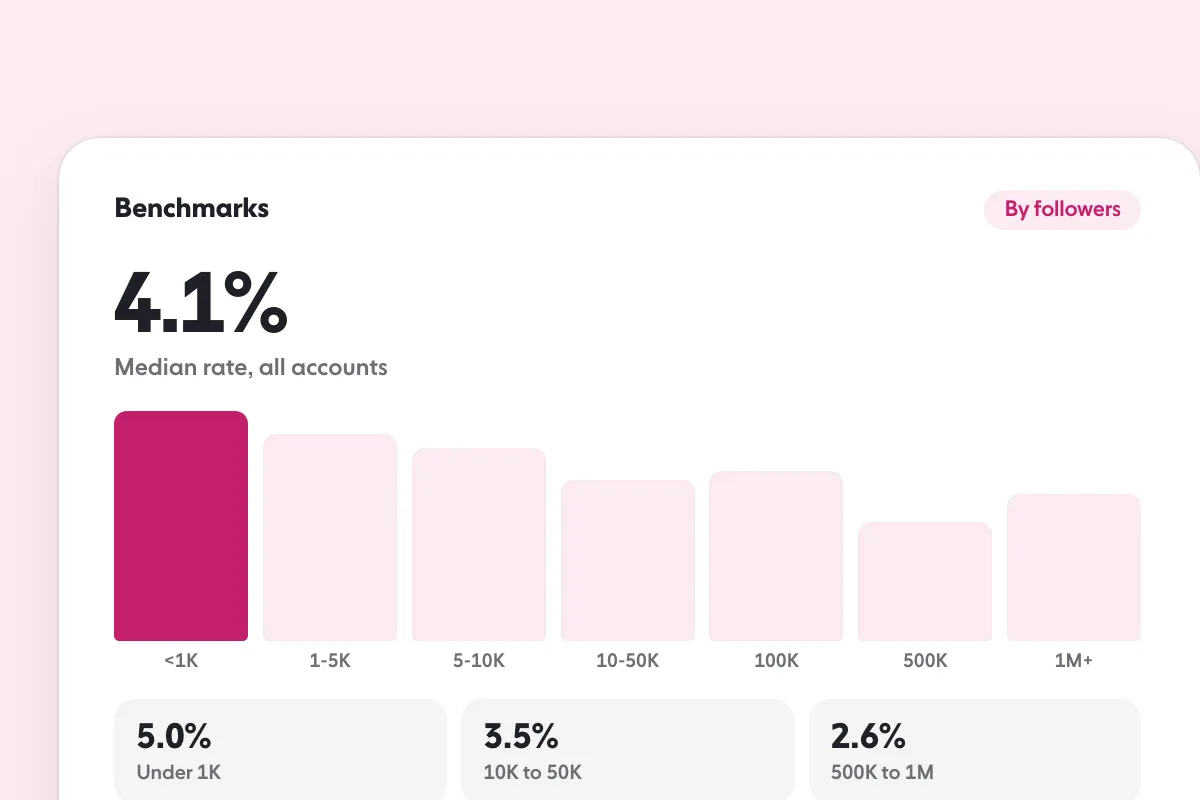
- Look at engagement, not only size. A smaller account whose followers react can be worth more to a brand than a larger one whose followers do not. See what a good engagement rate is for how to work yours out.
For the full set of ways to grow, from bio changes to Reels to collab posts, start with the main guide: how to get more Instagram followers. When you want to see what a growth plan involves, the pricing page lays out the options, and our Instagram statistics hub collects the other numbers we track.
What we could not source
We list these so you do not have to guess what the gaps are:
- No official average or median. We found no Instagram or Meta page that gives the mean or median followers of all accounts, so we do not state one.
- No all-account sample. The studies above select accounts that post sponsored content. Neither is a random sample of Instagram.
- No official tier definitions. The nano, micro, macro and mega edges come from researchers and differ by source.
- No current data on how follower counts are spread. The newest study is from October 2026, but its data was collected in 2024 or earlier (CrowdTangle closed in 2024), and the follower figures in the older paper are from 2019.
- Meta’s 3 billion is users, not accounts. Meta does not give an account count in the post we read.
When Instagram or an independent research body publishes a sampled follower distribution for all accounts, this page will be updated with it.
FAQ
What is the average number of followers on Instagram?
Instagram does not publish one. The only figures we found come from research on accounts that post sponsored content: a median of 23.7K followers in a 2020 study of about 12,000 accounts and about 51K for personal accounts in a 2026 study. Neither sample represents all 3 billion monthly users.
What is a good number of followers on Instagram?
There is no official benchmark. Instagram has no published tiers either; researchers use nano (under 10K), micro (10K to 100K), macro (100K to 1M) and mega (1M or more). A better test is whether your count is growing and whether the people following match the people you want to reach.
Do most Instagram accounts have under 1,000 followers?
No source we opened measures that for all accounts. In one 2026 study of personal accounts that posted sponsored content, 99,687 of about 402,000 (roughly 25%) had under 1,000 followers. In a 2020 study of accounts using sponsorship hashtags, 15.5% had under 1K. Both samples lean towards creators.
Why did my Instagram follower count change without me doing anything?
Instagram’s help center says a change in likes, follows or comments may be because some came from accounts generating inauthentic activity, and that it routinely removes disabled accounts, so follower totals "may change, even within a short time". A drop does not by itself mean something is wrong with your content.
How do I see my own follower numbers on Instagram?
For a public account, use Instagram’s free insights. Its help page lists a Total followers insight, available with at least 100 followers, covering growth (followers gained or lost), top locations, age range and the times followers are most active, for any period within the past 90 days.
Sources
- In India, Instagram debuts a Reels-first experience for its mobile app about.fb.com
- [2011.05757] Characterising and Detecting Sponsored Influencer Posts on Instagram arxiv.org
- Predicting Engagement with Sponsored Content Across Account Types on Instagram arxiv.org
- Americans' Use of Social Media in 2026 pewresearch.org
- About Instagram insights help.instagram.com
- Changes to your likes, follows or comments on Instagram help.instagram.com
- Why you should not use apps that offer likes and followers on Instagram help.instagram.com
Related guides
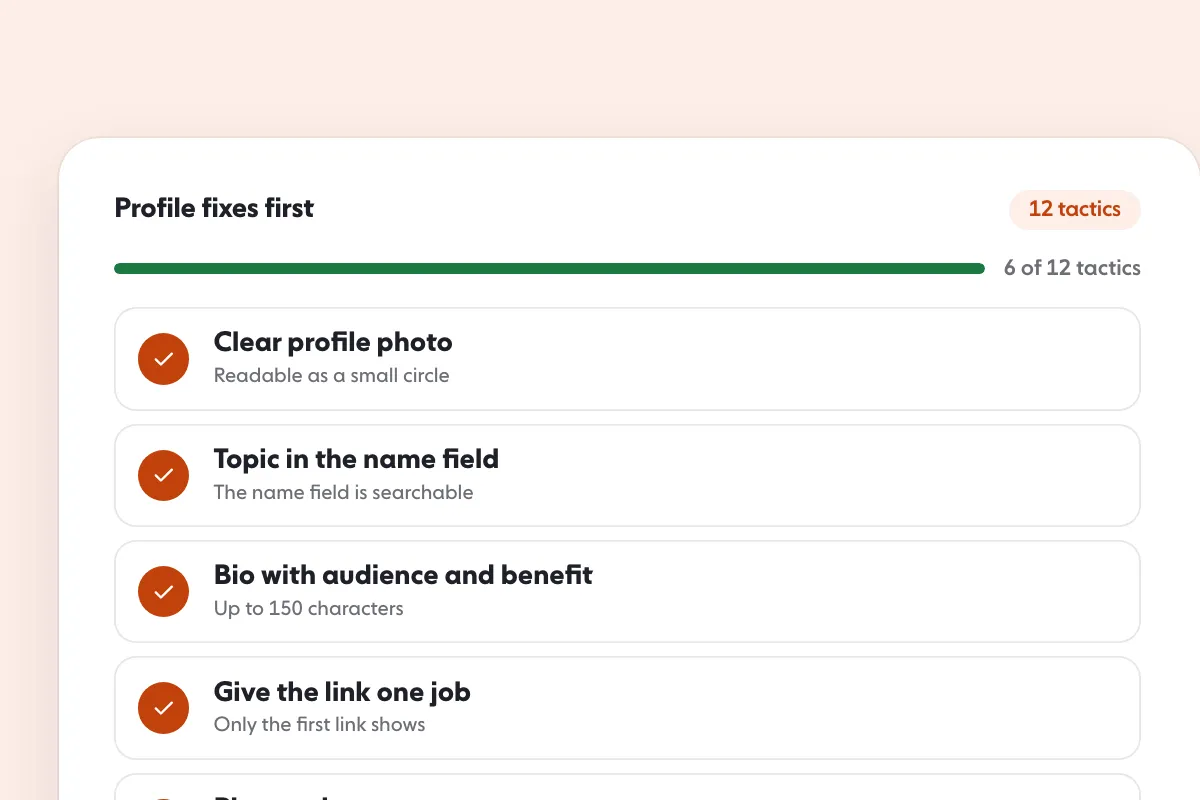
Follower growth
How to Get More Instagram Followers: 12 Tactics That Work
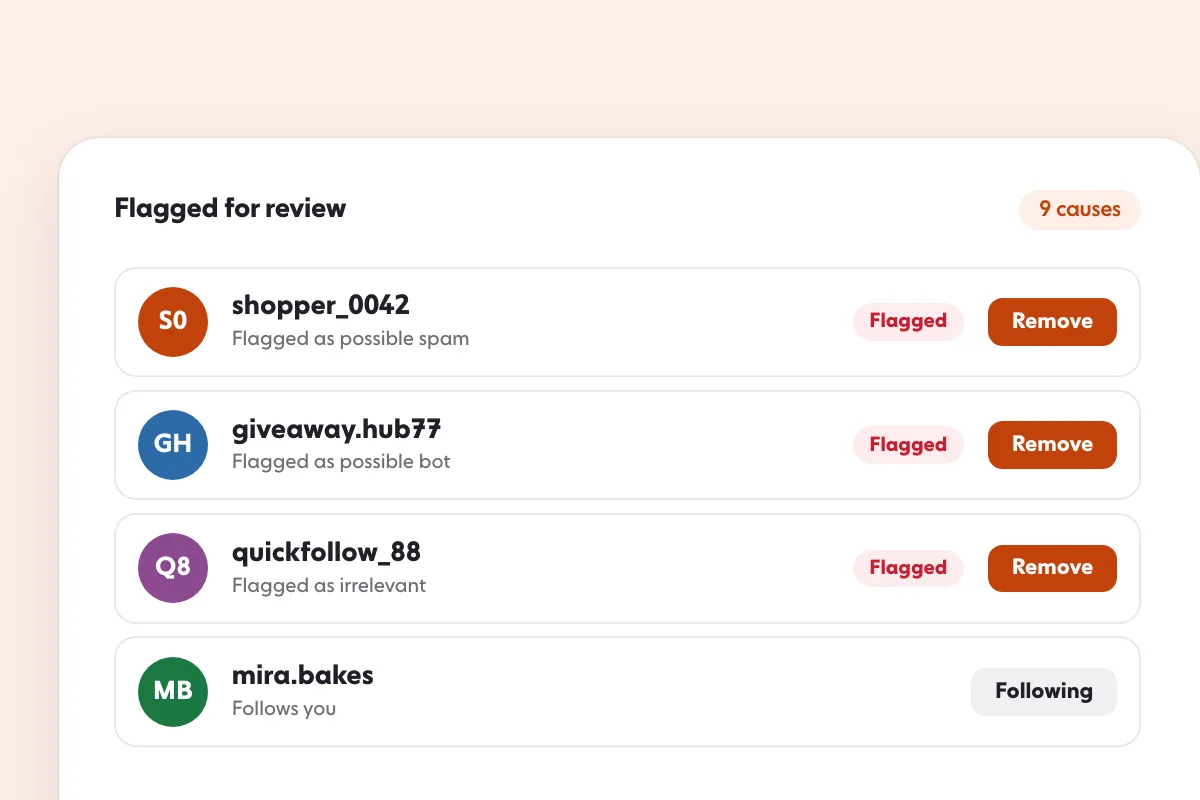
Follower growth
Why Am I Losing Instagram Followers? 9 Causes and Fixes
Written by Clara Ivens
Instagram growth editor
Clara Ivens covers Instagram growth on the SocialCaptain blog: followers, Reels, hashtags, bios, captions and how reach works. Each guide follows Instagram's own help pages and announcements, and lists its sources at the end.
All articles by Clara Ivens


